
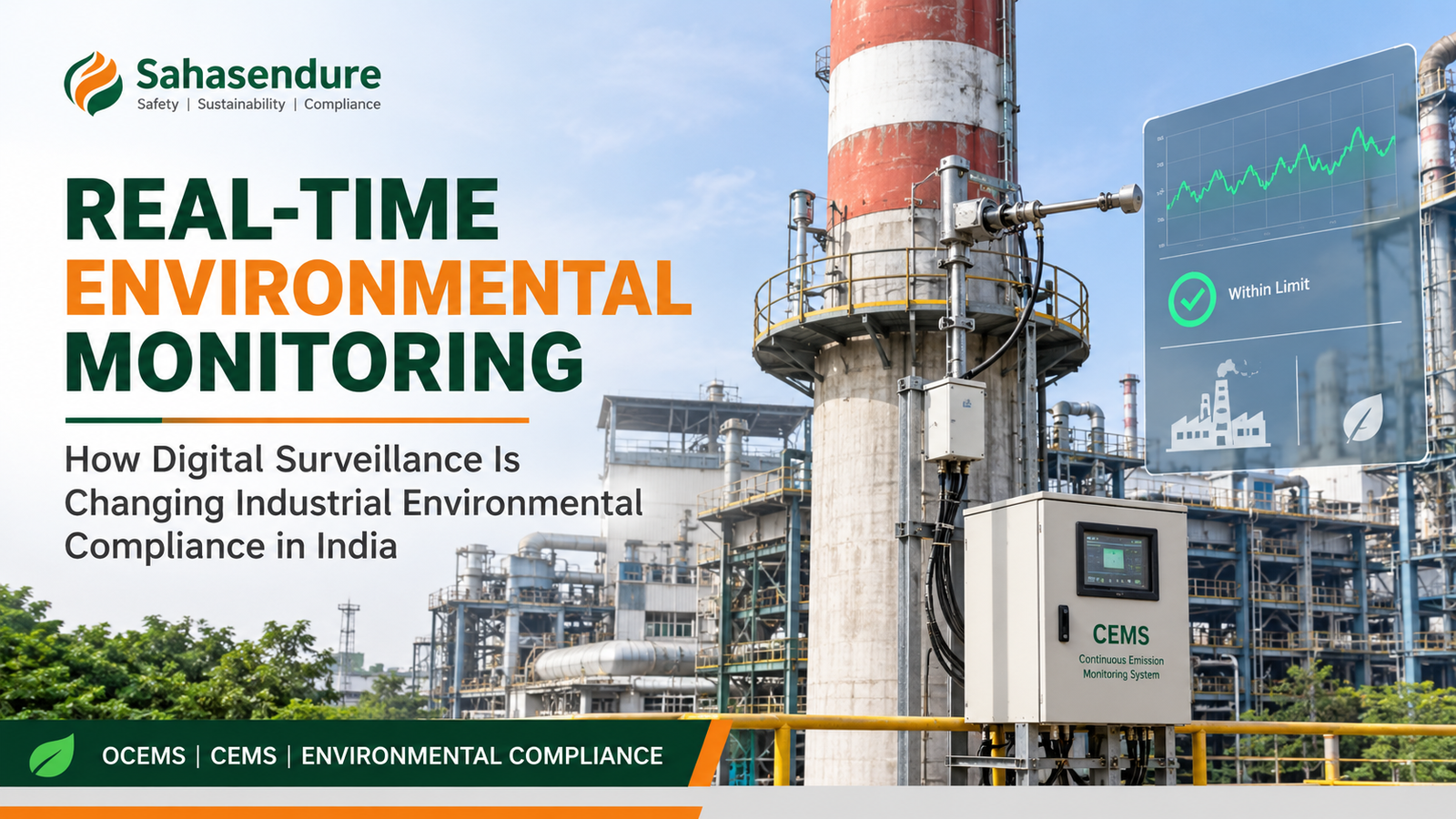
Environmental compliance in India is entering a more data-driven phase. Periodic inspections, laboratory reports and manually maintained records remain important. However, regulators are increasingly using online monitoring systems, digital dashboards and integrated surveillance platforms to improve visibility of industrial pollution.
On 14 November 2026, the Ministry of Environment, Forest and Climate Change reported a significant development. According to the Ministry, 2,298 of the 2,345 targeted industries in Delhi-NCR (98%) had connected to Online Continuous Emission Monitoring Systems (OCEMS). Meanwhile, authorities had closed or sealed the remaining 47 units.
This development highlights the growing importance of real-time environmental monitoring. Therefore, industries must ensure that their monitoring systems remain functional, transmit accurate data and support timely corrective action.
This update highlights the growing importance of digital environmental monitoring. For industrial organisations, it also raises practical questions: Are monitoring systems functioning correctly? Is the data reliable? Are abnormal readings investigated? Can the organisation demonstrate that corrective action has been taken?
Real-Time Environmental Monitoring in India is no longer just an equipment-related issue. It is becoming an important part of environmental compliance management, operational control and regulatory readiness.
[OFFICIAL SOURCE: Ministry of Environment, Forest and Climate Change – 14 November 2026: https://www.pib.gov.in/PressReleaseIframePage.aspx?PRID=2336168]
1. Environmental Compliance Is Moving Beyond Periodic Inspections
Traditional environmental compliance has largely depended on periodic sampling, laboratory analysis, physical inspections and statutory records. Although these activities remain essential, they offer only a snapshot of environmental performance. In contrast, continuous monitoring provides greater visibility into changing operating conditions.
For instance, an effluent sample collected during a scheduled inspection may meet the applicable discharge limits. However, that single result cannot confirm whether the treatment plant maintained the same performance throughout the month. Therefore, industries must monitor treatment processes regularly rather than rely only on occasional test results.
Similarly, a stack emission test may show acceptable performance during the testing period. Nevertheless, this result does not guarantee that air pollution control equipment will operate effectively during every production shift. Changes in production load, equipment condition or operating practices may affect emission levels.
This is where Real-Time Environmental Monitoring in India becomes increasingly valuable. Online monitoring systems provide frequent data on selected emission and effluent parameters. As a result, industries can identify abnormal conditions, analyse operational trends and respond more quickly to potential pollution-control failures.
Moreover, environmental managers should look beyond the availability of monitoring reports. They must verify equipment reliability, check data transmission and investigate deviations promptly. In addition, they should document corrective actions and review recurring problems to prevent future non-compliance.
Ultimately, effective environmental compliance requires more than collecting data. It demands continuous monitoring, timely investigation and consistent operational control.
2. What Is Real-Time Environmental Monitoring?
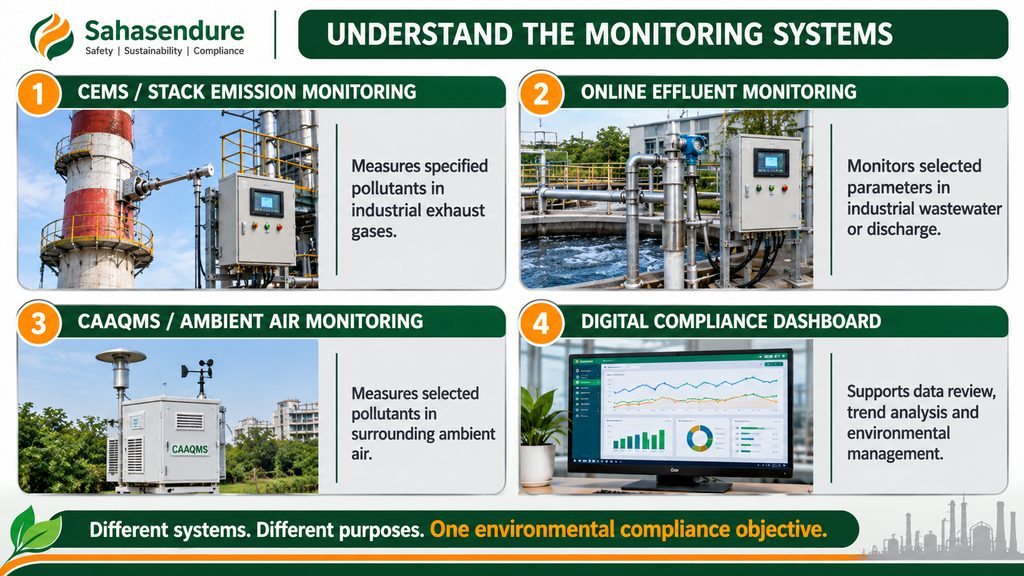
Real-Time Environmental Monitoring in India uses instruments, analysers, sensors and digital systems to measure selected environmental parameters and make the information available for operational review or regulatory reporting.
Different monitoring systems serve different purposes.
Online Continuous Emission Monitoring System (OCEMS)
OCEMS refers to online continuous monitoring arrangements used for specified industrial emissions and, where applicable, effluent parameters. The system enables selected measurements to be transmitted to regulatory monitoring platforms.
CPCB’s connectivity framework covers specified highly polluting industries, common facilities and other units directed by CPCB or the relevant SPCB to install OCEMS.
Read the official reference: CPCB – FAQ on OCEMS Connectivity.
Continuous Emission Monitoring System (CEMS)
CEMS refers to equipment used to continuously monitor specified pollutants in industrial exhaust gases. Depending on the installation, this may include particulate matter and gaseous pollutants such as sulphur dioxide and nitrogen oxides.
The system typically includes sampling arrangements, analysers, data acquisition equipment and associated communication infrastructure.
Online Effluent Monitoring
Online effluent monitoring measures selected parameters at industrial wastewater treatment or discharge locations.
Depending on the applicable requirements and installed equipment, parameters may include pH, flow, chemical oxygen demand (COD), biochemical oxygen demand (BOD) and total suspended solids (TSS).
Continuous Ambient Air Quality Monitoring
Continuous Ambient Air Quality Monitoring Stations (CAAQMS) assess pollutant concentrations in surrounding air. They are different from stack emission monitoring systems because they measure ambient air quality rather than emissions directly from an industrial exhaust point.
Typical parameters include PM10, PM2.5 and selected gaseous pollutants.
Digital Environmental Compliance Dashboards
Digital dashboards bring monitoring information together for operational and regulatory review. Depending on the platform, they may display pollutant readings, historical trends, alerts, equipment status and compliance information.
However, a dashboard is only as reliable as the instruments, data transmission and validation arrangements behind it.+

3. How OCEMS and CEMS Work
A typical online monitoring arrangement involves several connected stages.
1. Sample collection
A representative sample is collected from the designated stack, process stream or effluent monitoring point. The sampling location and arrangement must be suitable for the pollutant and operating conditions being measured.
2. Sensors and analysers
The collected sample is analysed using suitable instruments. The measurement principle depends on the parameter, sample characteristics and selected technology.
3. Measurement and data acquisition
The analyser generates measurement values. A data acquisition system records and processes the readings.
4. Data validation
The system may use data-quality checks, validation codes and other controls to identify abnormal or unreliable readings. Instrument faults and invalid measurements must not be mistaken for genuine environmental performance.
5. Data transmission
Monitoring data is transmitted through the designated communication arrangement.
CPCB’s OCEMS connectivity framework describes the role of Technology Providers for Data Submission (TPDS), which support data transmission from industrial systems to the regulatory platform.
6. Regulatory monitoring
The connected information becomes available to relevant regulatory authorities through their monitoring platforms, subject to the applicable connectivity and reporting arrangements.
7. Alerts and corrective action
Where the applicable monitoring system identifies an exceedance or specified deviation, alerts may be generated. The industry must investigate the condition, identify the reason and implement suitable corrective action.
For example, a sudden increase in stack particulate matter may require inspection of the air pollution control equipment, operating conditions, pressure indicators and associated process parameters.
The monitoring reading is an important signal. It does not, by itself, establish the underlying cause.
4. What Environmental Parameters Are Monitored?
Monitoring parameters depend on the industry, emission or discharge source, consent conditions and applicable regulatory directions.
| Monitoring category | Typical parameters | Practical purpose |
|---|---|---|
| Industrial stack emissions | Particulate matter, SO₂, NOx and other specified pollutants | Assess emissions from industrial processes |
| Industrial effluent | pH, flow, COD, BOD and TSS, where applicable | Assess wastewater quality and discharge performance |
| Ambient air | PM10, PM2.5 and relevant gaseous pollutants | Assess surrounding air quality |
| Process and treatment monitoring | Selected flow, pressure and operating indicators | Support treatment-system performance reviews |
This is an illustrative list, not a universal monitoring requirement. An industry must identify the parameters applicable to its processes, consent conditions and regulatory directions.
For example, a boiler-based operation and an industrial wastewater treatment facility may require entirely different monitoring configurations.
5. Why Is the Government Moving Towards Digital Environmental Surveillance?
Recent government developments indicate stronger emphasis on continuous data availability, integrated monitoring and coordinated regulatory action.
PAVAN-I3C: An integrated Real-Time Environmental Monitoring in India platform
On 30 October 2026, the Ministry of Environment reported the development of CAQM’s Integrated Command and Control Centre, named PAVAN (Platform for Air Quality Vigilance and Analytics for NCR).
According to the Ministry, the platform integrates more than 30 APIs and data streams covering air quality, emissions, meteorological information, satellite data, cameras, mobility, complaints and compliance information.
The same update reported integration of information from:
- 111 Continuous Ambient Air Quality Monitoring Stations across Delhi-NCR.
- More than 2,300 industries.
- Over 3,200 active construction sites.
- Traffic congestion and other pollution-related monitoring sources.
The platform follows a three-stage operating approach:
Detect: Identify abnormal conditions, pollution sources or compliance deviations.
Analyse: Review monitoring information, historical trends and supporting evidence.
Act: Refer alerts to the relevant agencies for investigation and enforcement action.
This approach can improve coordination between agencies and help identify locations requiring physical verification.
Official reference: MoEFCC/PIB – PAVAN-I3C Integrated Command and Control Centre, 30 October 2026.
The latest OCEMS connectivity update
On 14 November 2026, the Ministry of Environment, Forest and Climate Change reported a significant development. According to the Ministry, 2,298 of the 2,345 targeted industries in Delhi-NCR (98%) had connected to Online Continuous Emission Monitoring Systems (OCEMS). Authorities had closed or sealed the remaining 47 units..
The same update stated that the remaining 47 units had been closed or sealed. It also referred to OCEMS-based alerts and monitoring cells under the CPCB winter enforcement SOP, effective from 1 October 2026 to 28 February 2027.
These figures relate to the targeted industries in Delhi-NCR. They should not be interpreted as the national percentage of industries connected to OCEMS.
Official reference: MoEFCC/PIB – Delhi-NCR Air Pollution Review, 14 November 2026.
What does this mean for industrial organisations?
Digital surveillance can improve regulatory visibility in several ways:
- Continuous compliance visibility: Monitoring information can be reviewed beyond scheduled inspection dates.
- Faster identification of deviations: Abnormal readings can draw attention to potential pollution-control failures.
- Improved regulatory coordination: Integrated platforms help different agencies review information together.
- Evidence-based inspections: Digital information can help regulators identify locations requiring physical verification.
- Better operational decisions: Industries can use monitoring trends to identify recurring process and equipment problems.
The direction is clear: environmental data is becoming an increasingly important part of compliance management.
6. Common Technical Failures That Can Create Compliance Problems
Online monitoring equipment requires proper installation, operation, maintenance and data management. A system that is installed but poorly maintained may provide misleading or incomplete information.
| Technical issue | Possible consequence | Recommended preventive control |
|---|---|---|
| Improper sensor installation | Unrepresentative or unreliable readings | Verify sampling location, installation and suitability |
| Calibration failure | Incorrect measurement values | Follow applicable calibration and validation procedures |
| Sampling-line blockage | Interrupted or inaccurate sample collection | Inspect and maintain sampling lines |
| Instrument downtime | Gaps in monitoring records | Maintain preventive maintenance and breakdown records |
| Incorrect data transmission | Missing, delayed or inconsistent information | Check communication links and data transfer |
| Power interruptions | Monitoring equipment or communication failure | Provide suitable backup power arrangements |
| Poor maintenance documentation | Inability to demonstrate equipment upkeep | Maintain service reports and maintenance history |
| Data manipulation or bypassing | Loss of data integrity and serious compliance exposure | Restrict access, maintain audit trails and investigate irregularities |
Why calibration and validation matter
A monitoring system is only useful when its measurements are dependable.
Calibration, functional checks and validation help confirm that instruments are operating within their intended measurement performance. The frequency and method must follow applicable CPCB guidance, instrument requirements and regulatory directions.
CPCB’s revised CEMS guidance discusses instrument performance, calibration, validation and data quality. Industries should refer to the relevant technical requirements and current directions rather than applying a generic calibration schedule to every installation.
Technical reference: CPCB – Revised Guidelines for Continuous Emission Monitoring Systems.
Why data gaps should not be ignored
A missing data record does not automatically prove that an industry exceeded an emission limit. However, unexplained downtime can create questions about monitoring reliability and the adequacy of the compliance system.
Industries should record the reason for every significant interruption, its duration, corrective action, service support and restoration of connectivity.
7. What Should Industries Do to Maintain Compliance?
Real-Time Environmental Monitoring in India should be included in routine EHS and maintenance management arrangements.
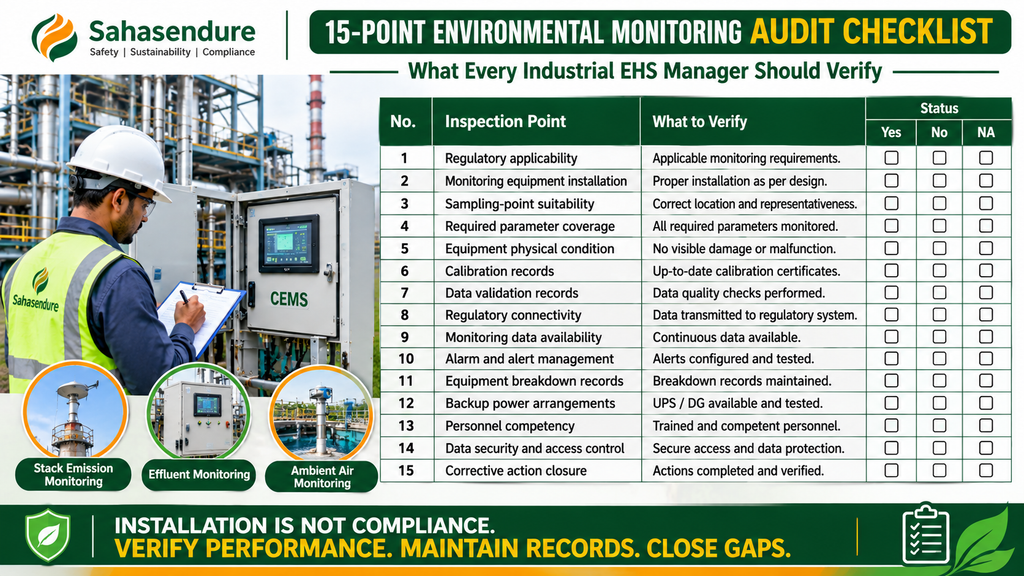
The following checklist can help environmental managers and EHS heads review system reliability.
Real-Time Environmental Monitoring in India management checklist
- Verify that the installed monitoring system meets applicable CPCB requirements and regulatory directions.
- Confirm that monitoring locations and sampling arrangements are appropriate.
- Check that installed analysers measure the required parameters.
- Maintain calibration and validation records.
- Establish preventive maintenance schedules.
- Ensure trained personnel are responsible for daily monitoring-system checks.
- Review data transmission and regulatory connectivity.
- Check the availability of backup power arrangements.
- Monitor equipment downtime and communication failures.
- Maintain service and breakdown reports.
- Review abnormal readings and exceedance alerts promptly.
- Record investigations and corrective actions.
- Restrict unauthorised access to monitoring systems.
- Maintain data integrity and system access records.
- Conduct periodic internal environmental compliance audits.
The organisation should also define clear responsibilities for every activity. For example, the environmental manager should coordinate compliance reviews, while maintenance personnel should ensure equipment reliability. Meanwhile, authorised operators should monitor daily system performance, identify abnormalities and report deviations promptly. This clear division of duties improves accountability and helps the organisation respond to environmental compliance issues more effectively.
8. Legal and Regulatory Responsibilities
Online monitoring requirements must be understood in the context of India’s environmental legislation and applicable regulatory directions.
Environment (Protection) Act, 1986
The Environment (Protection) Act, 1986 provides the central framework for environmental protection. It empowers the Central Government to prescribe environmental standards and issue directions.
Section 7 addresses restrictions on emissions or discharge of environmental pollutants beyond prescribed standards. Relevant rules, notifications and directions may establish additional requirements for industrial monitoring and pollution control.
Official legislation: India Code – Environment (Protection) Act, 1986.
Water (Prevention and Control of Pollution) Act, 1974
The Water Act regulates the prevention and control of water pollution. Industries must comply with applicable requirements concerning effluent discharge, treatment and consent conditions.
Online effluent monitoring may be required for specified industries and facilities under relevant directions.
Official legislation: India Code – Water (Prevention and Control of Pollution) Act, 1974.
Air (Prevention and Control of Pollution) Act, 1981
The Air Act provides the framework for prevention, control and abatement of air pollution. Industrial units must comply with applicable emission standards, consent conditions and directions issued by competent authorities.
Official legislation: India Code – Air (Prevention and Control of Pollution) Act, 1981.
CPCB directions and State Pollution Control Board conditions
CPCB has issued OCEMS guidelines, technical protocols and connectivity-related instructions for specified industries and facilities.
The CPCB’s published OCEMS FAQ identifies 17 categories of highly polluting industries. It also covers common facilities, including STPs, ETPs, Common TSDFs and CBWTFs. Furthermore, CPCB or State Pollution Control Boards (SPCBs) may direct other industries to install OCEMS, depending on applicable requirements.
In addition, Consent to Establish (CTE) and Consent to Operate (CTO) conditions may specify monitoring, reporting, sampling and pollution-control obligations. Therefore, industries should not rely on general guidance alone.
Instead, they should review their current consent documents and identify the exact requirements for each emission source and discharge point. This review helps organisations understand their monitoring responsibilities and avoid gaps in regulatory compliance.
Important compliance distinction: Installing OCEMS or CEMS does not automatically establish environmental compliance. Although these systems provide valuable monitoring data, organisations must still meet applicable emission and effluent standards. They must also operate pollution-control equipment effectively and follow every relevant consent condition.
Finally, organisations should verify the applicability of each requirement against the latest notifications, regulatory directions, industry category and state-specific instructions before implementation. This approach helps prevent incorrect interpretations and supports more reliable environmental compliance.
9. EHS Manager’s Real-Time Monitoring Audit Checklist
The following table can be used during an internal environmental compliance review.
| Inspection point | What to verify | Evidence/document required |
|---|---|---|
| 1. Regulatory applicability | Whether OCEMS/CEMS is required for the unit | CPCB/SPCB directions and consent conditions |
| 2. Installation status | Whether required monitoring equipment is installed | Installation and commissioning report |
| 3. Monitoring location | Whether the sampling point is appropriate | Approved layout and installation details |
| 4. Parameter coverage | Whether all required parameters are monitored | Parameter list and system configuration |
| 5. Equipment condition | Physical condition of analysers and accessories | Inspection records |
| 6. Calibration | Whether calibration is performed as required | Calibration certificates and logs |
| 7. Validation | Whether readings are periodically validated | Validation and laboratory reports |
| 8. Data connectivity | Whether required regulatory connectivity is active | Connectivity confirmation and portal records |
| 9. Data availability | Whether data gaps or interruptions are recorded | Historical monitoring data |
| 10. Alarm management | Whether alerts are reviewed and investigated | Alert logs and investigation reports |
| 11. Breakdown management | Whether instrument failures are addressed | Breakdown and service reports |
| 12. Backup power | Whether suitable backup arrangements exist | UPS or power-backup inspection records |
| 13. Personnel competency | Whether responsible operators are trained | Training and competency records |
| 14. Data security | Whether access is controlled and changes are traceable | Access logs and system records |
| 15. Corrective actions | Whether identified gaps are closed effectively | CAPA tracker and closure evidence |
The audit should not stop at checking whether equipment exists. It should establish whether the system is functional, whether information is reliable and whether the organisation responds effectively to deviations.

10. What Happens When Monitoring Data Indicates Non-Compliance?
An abnormal reading or monitoring alert should be treated as a signal requiring investigation. The industry should not ignore it or assume that it is automatically a technical error.
A practical response should include the following steps.
Step 1 – Verify the reading
Check analyser status, sampling arrangements, data-quality indicators and operating conditions.
Step 2 – Investigate the process
Review the relevant production activity, pollution-control equipment and operating parameters.
Step 3 – Identify the reason
Determine whether the deviation is related to process conditions, equipment performance, maintenance, sampling or another factor.
Step 4 – Implement corrective action
Take appropriate action to restore pollution-control performance and prevent recurrence.
Step 5 – Document the response
Record the alert, investigation, corrective action, responsible personnel and closure evidence.
Step 6 – Complete regulatory communication
Follow applicable reporting, response and communication requirements. Where a regulator has issued a notice or direction, comply with its specified requirements and timelines.
Depending on the circumstances, persistent or established non-compliance may lead to regulatory scrutiny, field inspections, show-cause notices, environmental compensation, consent-related action or other statutory measures.
The actual consequences depend on the applicable law, directions, evidence and facts of the case. An isolated monitoring alert should not be treated as an automatic closure order or penalty.
11. The Future of Environmental Compliance in India
Digital monitoring is creating opportunities to improve both regulatory oversight and industrial environmental management.
Several developments are particularly relevant.
AI-assisted anomaly detection: Analytical systems may help identify unusual patterns in monitoring data and highlight conditions requiring investigation. Such alerts still need technical verification.
Integrated environmental dashboards: Common platforms can bring together information from emissions, ambient air, meteorology, cameras and field inspections.
Predictive maintenance: Historical equipment data can help identify recurring failures and plan maintenance before a major breakdown occurs.
Automated alerts: System-generated notifications can support faster communication when specified conditions are detected.
Digital compliance records: Electronic records can improve traceability, reporting and evidence management.
Trend-based risk assessment: Monitoring trends can help environmental managers identify recurring deviations, process weaknesses and opportunities for pollution prevention.
PAVAN-I3C is an example of the growing use of integrated environmental data for monitoring and coordinated enforcement in Delhi-NCR. Wider adoption of similar technology and analytical capabilities will depend on regulatory decisions, infrastructure and implementation.
For industries, the practical priority is to build reliable monitoring and response systems rather than wait for further digital enforcement developments.
12. How Sahasendure Solutions LLP Can Support Industries
Sahasendure Solutions LLP supports organisations in strengthening EHS management and environmental compliance through practical assessments and consulting support.
Our relevant areas of support include:
- Environmental compliance gap assessments.
- Environmental monitoring-system documentation reviews.
- EHS and environmental compliance audits.
- Regulatory compliance tracking.
- Corrective and preventive action planning.
- Environmental management system improvement.
The objective is to help organisations identify compliance gaps, improve monitoring arrangements and strengthen the implementation of environmental management practices.
Explore our services:
- EHS Audit & Compliance Assurance
- Industrial Safety Services
- Incident Investigation & Risk Analysis
- Training & Capacity Building
For more information about our work, visit Sahasendure Solutions LLP.
Conclusion: Environmental Compliance Must Be Continuous
Environmental compliance should not be treated as a periodic documentation exercise.
India’s growing use of online monitoring, integrated data platforms and technology-supported regulatory surveillance is increasing the importance of reliable environmental information.
Industries must ensure that monitoring systems are properly installed, maintained and calibrated. They must also protect data integrity, investigate abnormal readings and implement corrective actions without delay.
A monitoring system is only as effective as the action taken on the information it provides.
For industrial organisations, the priority should be clear: maintain reliable data, control pollution at source and demonstrate compliance through consistent operational performance.
Frequently Asked Questions
1. What is OCEMS in environmental compliance?
OCEMS stands for Online Continuous Emission Monitoring System. It is used to monitor specified industrial emission and, where applicable, effluent parameters and transmit data to regulatory monitoring platforms.
2. Is OCEMS mandatory for every industry in India?
No. OCEMS requirements depend on applicable CPCB or SPCB directions, industry category, common facility requirements and specific regulatory conditions. Industries should verify their individual applicability.
3. What is the difference between OCEMS and CEMS?
CEMS generally refers to continuous emission monitoring equipment used for stack emissions. OCEMS is commonly used in the Indian regulatory context for online monitoring and connectivity arrangements covering specified emissions and effluent monitoring.
4. Does installing OCEMS guarantee environmental compliance?
No. Installation and connectivity do not automatically establish compliance. Industries must also meet applicable emission and effluent standards, maintain pollution-control systems and comply with consent conditions.
5. What should an industry do when an OCEMS alert is generated?
The industry should verify the reading, check instrument and process conditions, investigate the reason, implement corrective action and maintain records. Applicable regulatory reporting and response requirements must also be followed.
About the Author
OSH Consultant | Fire & Safety Professional
Anshul Shridhar is an OSH consultant with an academic background in Fire Technology and Safety. His professional focus includes EHS audits, occupational safety, fire safety, risk assessment, incident investigation and safety management systems.
Through his technical articles and industry insights, he aims to help organisations strengthen workplace safety, improve regulatory compliance and manage operational risks.