
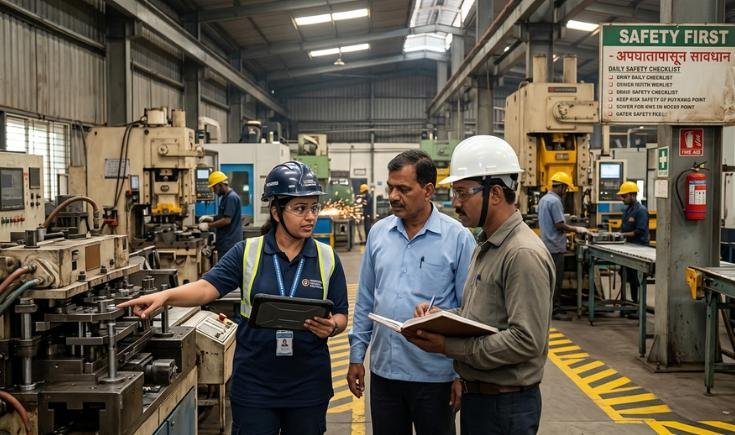
Factury safety in India’s manufacturing ambitions are growing rapidly. However, a factory’s success cannot be measured only by production capacity, investment or output. Equally important is whether its workforce returns home safely every day.
The importance of Factory Safety in India has come into focus again following the deaths of three contract workers during maintenance work at an effluent-treatment facility at a manufacturing plant near Hosur, Tamil Nadu, in November 2026.
Meanwhile, India’s manufacturing sector recorded 7.6% year-on-year growth in September 2026, according to the Ministry of Statistics and Programme Implementation’s provisional Index of Industrial Production estimates.
Together, these developments raise an important question: as manufacturing expands, are workplace risk management, engineering safeguards and contractor safety systems improving at the same pace?
Industrial growth and occupational safety must progress together. Ultimately, a production target should never take priority over the controls needed to protect workers.
1. Factory Safety in India’s Manufacturing Growth and the Safety Challenge
India’s industrial expansion is supported by manufacturing investment, infrastructure development, domestic production initiatives and increasing participation in global supply chains.
According to the Ministry of Statistics and Programme Implementation:
- Overall Index of Industrial Production growth of 6.7% in September 2026.
- Manufacturing sector growth of 7.6%.
- Electrical equipment manufacturing growth of 33.9%.
- Motor vehicles, trailers and semi-trailers manufacturing growth of 19.0%.
- Rubber and plastics products manufacturing growth of 19.9%.
These September figures were provisional quick estimates released on 28 October 2026.
Source: Ministry of Statistics and Programme Implementation – September 2026 IIP release.
Manufacturing growth brings more than new machinery and production capacity. In practice, it can also mean:
- More workers operating machinery and automated systems.
- Increased movement of raw materials and finished products.
- Greater use of chemicals, gases and industrial utilities.
- More maintenance, cleaning and shutdown activities.
- Higher dependence on contractors and outsourced services.
- Greater demand for electrical systems, pressure equipment and process utilities.
Each of these activities introduces risks that must be identified and controlled.
For example, a new production line may introduce conveyor nip points, robotic movement, electrical hazards and new maintenance requirements. Similarly, an expanded effluent-treatment plant may introduce chemical exposure, biological hazards and confined-space risks.
Manufacturing expansion should therefore be accompanied by updated risk assessments, competent supervision, safe operating procedures and adequate emergency arrangements.

Six major industrial hazards in manufacturing including mechanical, electrical, fire, chemical, ergonomic and material handling risks.
2. Why Factory Safety in India Is Becoming a Business Priority
Factory safety is often treated as a statutory responsibility of the EHS department. In reality, however, it is a management responsibility that directly affects production, business continuity and workforce performance.
What do India’s factory injury figures indicate?
The Directorate General Factory Advice Service and Labour Institutes (DGFASLI), in its Standard Reference Note 2024, reported 1,090 fatal injuries in registered factories during 2023.
Furthermore, its 2014–2023 data recorded:
- 338 fatal injuries attributed to gassing.
- 956 fatal injuries attributed to fire.
- 924 fatal injuries attributed to explosions.
- 1,231 fatal injuries involving machinery moved by mechanical power.
- 2,101 fatal injuries involving persons falling.
These are cumulative figures for the ten-year period 2014–2023, not annual totals.
The data highlights why machine safety, fire prevention, hazardous maintenance and work-at-height controls deserve sustained attention. Moreover, the figures relate to registered factories and should not be interpreted as a complete count of every occupational injury in India.
Source: DGFASLI – Standard Reference Note 2024.
The business consequences of weak safety management
An industrial accident can result in:
- Production disruption: Equipment damage, investigations and unsafe operating conditions can interrupt manufacturing.
- Financial exposure: Compensation, repair costs, insurance implications and legal proceedings may create substantial financial pressure.
- Workforce impact: Serious incidents affect employee confidence, morale and retention.
- Regulatory consequences: Non-compliance may lead to enforcement action, restrictions or other consequences under applicable law.
- Reputational damage: Customers, investors and supply-chain partners increasingly expect responsible workplace management.
For these reasons, EHS should be integrated into production planning, maintenance, procurement, contractor selection and operational decision-making.

Twelve critical factory safety controls for Indian manufacturing facilities.
3. The Hosur Incident: A Reminder About Hazardous Maintenance
On 10 November 2026, three contract workers died during maintenance work at an effluent-treatment facility at a Tata Electronics manufacturing plant near Hosur, Tamil Nadu.
Reuters reported that the workers inhaled gas while inspecting an external nano-filtration tank. The facility was operated by Nalco Water, while the workers were engaged through a subcontractor. At the time of reporting, investigations by the relevant authorities and companies were ongoing.
Importantly, the final technical cause and the complete sequence of events had not been established in the reporting available for this article.
Reference: Reuters – Three workers die at Tata’s India iPhone parts factory.
This incident highlights an important EHS principle: maintenance and cleaning activities can carry serious risks even when they take place outside the main production line.
Industrial tanks, pits, chambers and process vessels may contain hazardous atmospheres, toxic gases, oxygen-deficient environments or residues capable of producing dangerous reactions.
Rather than speculate about the incident’s cause, organisations should examine whether similar high-risk work at their own facilities is supported by a properly designed safety system.
For hazardous maintenance, organisations should consider:
- A documented task-specific risk assessment.
- Identification of whether the space meets the applicable confined-space definition.
- Avoidance of entry wherever a safe alternative is practicable.
- Isolation of connected pipelines, pumps and energy sources.
- Atmospheric testing using suitable calibrated instruments.
- Ventilation and continuous monitoring where required by the risk assessment.
- A controlled entry permit and trained authorised personnel.
- A standby attendant and reliable communication.
- A planned rescue arrangement with suitable equipment and trained rescuers.
A worker collapsing inside a tank must never trigger an uncontrolled rescue entry by another worker. Therefore, rescue arrangements must be planned before the task begins.
4. Twelve Critical Factory Safety in India Controls Every Manufacturing Facility Should Implement
A reliable Industrial Safety Management system must translate risk assessments into physical safeguards, operating controls and field verification.
1. Machine guarding and mechanical safety
Hazard: Rotating shafts, gears, conveyors, cutting equipment and nip points.
Possible incident: A worker’s clothing, hand or limb becomes entangled in an exposed moving component.
Preventive controls:
- Fixed and interlocked guards.
- Suitable emergency-stop arrangements.
- Safe access for cleaning and maintenance.
- Inspection of guards after equipment modification.
- Safe isolation before intervention.
Audit checkpoints: Check exposed moving parts, guard integrity, interlock functionality and emergency-stop accessibility.
2. Electrical safety
Hazard: Damaged cables, exposed live parts, defective earthing and overloaded circuits.
Possible incident: Electric shock, arc flash or an electrical fire during operation or maintenance.
Preventive controls:
- Properly designed and maintained electrical installations.
- Suitable earthing and protective devices.
- Restricted access to electrical panels.
- Authorised electrical maintenance.
- Inspection and testing records.
Audit checkpoints: Verify panel condition, cable routing, earthing records, protection arrangements and access restrictions.
3. Fire prevention and fire protection
Hazard: Combustible materials, flammable liquids, hot work and electrical faults.
Possible incident: A small fire spreads through a storage area or production section.
Preventive controls:
- Fire-load assessment.
- Safe chemical and combustible storage.
- Hot-work permits and fire watch.
- Suitable detection, alarm and firefighting systems.
- Accessible emergency exits.
Audit checkpoints: Check extinguishers, hydrants, alarms, exit routes, fire doors and inspection records.
4. Lockout/Tagout (LOTO)
Hazard: Unexpected energisation or release of stored energy.
Possible incident: A machine starts while a technician is clearing a jam or performing maintenance.
Preventive controls:
- Identify all energy sources.
- Isolate electrical, mechanical, hydraulic and pneumatic energy.
- Apply personal locks and identification tags.
- Release or restrain stored energy.
- Verify zero-energy condition before work.
Audit checkpoints: Observe actual isolation practices, check isolation registers and verify that workers understand equipment-specific procedures.
5. Work-at-height safety
Hazard: Unprotected platforms, ladders, roofs and maintenance locations.
Possible incident: A worker falls while accessing a motor, overhead pipeline or elevated platform.
Preventive controls:
- Eliminate work at height where practicable.
- Use properly designed platforms and scaffolds.
- Provide guardrails and safe access.
- Use suitable fall-protection systems where required.
- Plan rescue arrangements.
Audit checkpoints: Inspect platforms, ladders, scaffold tags, access points and fall-protection equipment.
6. Confined-space safety
Hazard: Oxygen deficiency, toxic or flammable atmospheres and restricted escape.
Possible incident: A worker becomes unconscious inside a tank or chamber, followed by additional casualties during an attempted rescue.
Preventive controls:
- Assess and classify the space.
- Avoid entry wherever possible.
- Isolate connected services and energy sources.
- Test the atmosphere before entry and monitor as necessary.
- Provide ventilation, entry permits, attendants and a planned rescue system.
Audit checkpoints: Review permits, gas-testing records, instrument calibration, isolation arrangements and rescue readiness.
7. Chemical handling and storage
Hazard: Incompatible chemicals, leaks, vapour exposure and uncontrolled reactions.
Possible incident: Chemical mixing generates toxic vapour or a leaking container exposes workers.
Preventive controls:
- Maintain current Safety Data Sheets (SDS).
- Use compatible storage arrangements.
- Provide clear container labels.
- Establish spill response procedures.
- Provide suitable ventilation and exposure controls.
- Train personnel in handling and emergency response.
Audit checkpoints: Check labels, segregation, storage compatibility, spill kits, eyewash facilities and SDS availability.
8. Material handling and lifting operations
Hazard: Suspended loads, unstable stacks, forklift movement and damaged lifting accessories.
Possible incident: A suspended load falls or a forklift strikes a pedestrian.
Preventive controls:
- Approved lifting plans for critical lifts.
- Inspected cranes and lifting accessories.
- Competent operators and riggers.
- Pedestrian and vehicle segregation.
- Safe stacking and load limits.
Audit checkpoints: Inspect lifting equipment records, accessories, operator authorisations, traffic routes and pedestrian barriers.
9. Contractor safety management
Hazard: Contractors performing unfamiliar or high-risk work without adequate site knowledge or supervision.
Possible incident: A maintenance contractor begins hot work or opens equipment without understanding the isolation and emergency requirements.
Preventive controls:
- Contractor prequalification.
- Task-specific induction.
- Competency verification.
- Permit-to-work and risk assessment.
- Defined supervision and coordination.
- Performance monitoring and corrective action.
Audit checkpoints: Review contractor documents, induction records, permits, toolbox talks and site supervision.
10. Occupational health and ergonomics
Hazard: Noise, heat, dust, poor ventilation, repetitive movements and manual handling.
Possible incident: Workers develop hearing loss, heat-related illness, respiratory problems or musculoskeletal disorders.
Preventive controls:
- Workplace exposure assessment.
- Engineering controls and local exhaust ventilation.
- Noise reduction and suitable hearing protection.
- Heat-stress management.
- Ergonomic workstation design.
- Occupational health surveillance as applicable.
Audit checkpoints: Review exposure monitoring, ventilation performance, health records, ergonomics assessments and worker complaints.
11. Emergency preparedness
Hazard: Delayed response to fire, chemical release, medical emergencies or major equipment failure.
Possible incident: Workers cannot evacuate promptly because alarms, routes or emergency responsibilities are unclear.
Preventive controls:
- Site-specific emergency plans.
- Clearly assigned emergency roles.
- Functional alarms and communication systems.
- Accessible first-aid facilities.
- Regular mock drills.
- Coordination with external emergency services where necessary.
Audit checkpoints: Review drill reports, evacuation arrangements, emergency contacts, assembly points and corrective actions.
12. Incident reporting and root cause analysis
Hazard: Repeated unsafe conditions and near misses remain unreported or unresolved.
Possible incident: A recurring equipment defect eventually results in a serious injury.
Preventive controls:
- Encourage near-miss reporting.
- Investigate incidents and dangerous occurrences.
- Identify immediate and underlying causes.
- Assign corrective actions to responsible persons.
- Verify the effectiveness of completed actions.
Audit checkpoints: Review incident registers, investigation reports, action trackers and repeat-finding trends.
5. Indian Legal and Regulatory Framework for Factory Safety in India
India’s occupational safety framework changed significantly with the commencement of the Occupational Safety, Health and Working Conditions Code, 2020.
Occupational Safety, Health and Working Conditions Code, 2020 for
The OSHWC Code came into force on 21 November 2025, under the commencement notification S.O. 5321(E).
Subsequently, the Occupational Safety, Health and Working Conditions (Central) Rules, 2026 were notified on 8 May 2026. However, the appropriate government and applicable rules depend on the establishment and its jurisdiction. Therefore, state rules and notifications must be checked before making a facility-specific compliance determination.
The Code provides for employer duties concerning workplace safety, health and working conditions. Relevant responsibilities include maintaining safe systems of work, protecting workers from hazards and complying with applicable safety standards.
Reference: India Code – OSHWC Code, 2020.
What about the Factories Act, 1948?
The Factories Act, 1948 formed the earlier central framework for factory health, safety and welfare. Following the commencement of the OSHWC Code, the earlier framework is subject to the Code’s repeal and savings provisions.
Consequently, facilities should not rely on an old Factories Act compliance checklist without reviewing the current Code, applicable rules, transitional provisions and relevant state notifications.
Other important legal and technical requirements
Depending on the facility’s activities, location and risk profile, the following may also be relevant:
- Environment (Protection) Act, 1986: Provides the umbrella framework for environmental protection and related rules and notifications.
- Manufacture, Storage and Import of Hazardous Chemical Rules, 1989: Relevant where hazardous chemicals and applicable threshold or activity conditions are met.
- Central Electricity Authority (Measures relating to Safety and Electric Supply) Regulations, 2023, as amended: Relevant to electrical safety and electric supply installations.
- State fire service legislation and local building/fire requirements: Applicability depends on the location, building use and facility characteristics.
- Applicable pollution-control consents and environmental conditions: Relevant to facilities with regulated emissions, effluent discharge and waste management.
For hazardous processes and major accident hazards, the organisation must identify the applicable provisions, threshold quantities, reporting duties and emergency planning requirements. In other words, it should not assume that every factory is subject to the same obligations.
Legal applicability should be confirmed using the latest official Gazette notifications, state rules, licence conditions and regulator directions.
6. Is Your Factory Audit-Ready? A Practical EHS Checklist
Use the following checklist during an internal factory safety in india audit. However, the evidence required will vary with the facility, equipment and legal applicability.
| Inspection area | What to verify | Evidence/document | Risk if uncontrolled |
|---|---|---|---|
| Machine guarding | Guards and interlocks | Inspection records | Entanglement or amputation |
| Electrical safety | Panels, earthing and protection | Test records | Shock or fire |
| Fire protection | Alarms and firefighting systems | Inspection logs | Fire escalation |
| Emergency exits | Clear and accessible routes | Site inspection | Delayed evacuation |
| LOTO | Energy isolation practices | Isolation procedure | Unexpected start-up |
| PPE | Task-specific suitability | PPE issue and inspection records | Exposure or injury |
| Chemical storage | Labels and compatibility | SDS and inventory | Chemical reaction or exposure |
| Lifting equipment | Inspection and safe use | Certificates and registers | Dropped loads |
| Contractor management | Induction and supervision | Contractor records | Uncontrolled work |
| Training | Competency for assigned tasks | Training and assessment records | Unsafe operation |
| Work permits | Field verification and authorisation | PTW register | High-risk task incidents |
| Incident register | Near misses and incidents | Investigation reports | Repeat accidents |
| Mock drills | Emergency response performance | Drill reports | Delayed response |
| Risk assessments | Current task and process hazards | HIRA/JSA records | Unidentified risks |
| Corrective actions | Closure and effectiveness | Action tracker | Repeat findings |
An audit should not end when a checklist is completed. Instead, findings must be classified by risk, assigned to responsible persons and verified after corrective action.
7. Five Common Factory Safety in India Mistakes
1. Treating safety audits as paperwork exercises
A signed checklist does not prove that a machine guard works or an emergency exit is accessible. Therefore, auditors should verify actual site conditions and speak with workers.
2. Providing PPE without controlling the hazard
PPE is an important last line of defence, but it should not replace feasible engineering controls. For example, providing earplugs does not remove the need to assess and reduce excessive noise.
3. Issuing permits without field verification
A hot-work or confined-space permit is not a substitute for checking the work area, isolation, atmosphere, equipment and emergency arrangements.
4. Conducting training without competency evaluation
Attendance alone does not demonstrate that a worker can operate equipment safely or perform an emergency response task. Therefore, practical demonstrations and assessments are essential.
5. Closing audit findings without checking effectiveness
An action marked complete may not have removed the underlying risk. Furthermore, repeated findings should trigger a review of the original risk assessment and corrective action.
8. A Practical 30-Day Factory Safety in India Improvement Plan
Manufacturing management can begin with a focused 30-day review. This is an improvement framework, not a substitute for statutory deadlines or a complete compliance programme.
1st Week – Identify critical hazards and gaps
- Conduct a walkthrough of production, maintenance, warehouse and utility areas.
- Identify high-risk machinery and hazardous processes.
- Review recent incidents and near misses.
- Check contractor activities and overdue audit findings.
- Prepare a prioritised risk register.
2nd Week – Review safeguards and operating controls
- Verify critical machine guards and emergency stops.
- Review electrical safety and energy isolation.
- Check fire protection and emergency exits.
- Review confined-space and hot-work permits.
- Verify chemical storage and lifting arrangements.
3rd Week – Improve workforce and contractor competence
- Conduct task-specific safety briefings.
- Evaluate machine operator and maintenance competency.
- Refresh contractor induction and supervision arrangements.
- Conduct emergency response training.
- Communicate incident-reporting expectations.
4th Week – Audit, verify and review
- Conduct an internal EHS audit.
- Verify closure of high-risk findings.
- Review emergency drill performance.
- Check permit compliance and training effectiveness.
- Present unresolved risks to management for decisions and resources.
What should management measure?
Useful leading indicators include:
- Number of critical audit findings still open.
- Percentage of high-risk machine safeguards physically verified.
- Permit-to-work field verification results.
- Training competency assessment completion.
- Emergency drill observations and corrective actions.
- Repeat audit findings and overdue corrective actions.
These indicators should be based on actual records. Additionally, avoid setting arbitrary targets without understanding the facility’s baseline and risk profile.

Four-week factory safety action plan covering risk identification, safeguards, workforce training and EHS audit verification.
9. Conclusion: Safer Factories, Stronger Manufacturing
India’s manufacturing growth and workplace safety should not compete with each other.
A factory that invests in safe machinery, reliable maintenance systems, competent workers, contractor supervision and emergency preparedness is better positioned to manage operational risk.
The Hosur incident is a reminder that hazardous work does not become safe simply because it is outsourced or performed outside the main production area. Every organisation must understand the risks created by its operations and ensure that the people performing the work are adequately protected.
A safer factory is a stronger factory. Ultimately, industrial progress becomes meaningful only when production growth is supported by effective risk management, competent workers and accountable leadership.
Is your manufacturing facility prepared for its next EHS inspection?
Sahasendure Solutions LLP supports organisations in identifying workplace risks, strengthening EHS systems and improving practical compliance through:
- Industrial EHS audits and factory safety in India inspections.
- Risk assessments and compliance gap assessments.
- ISO 45001 and ISO 14001 implementation support.
- SOP and permit-to-work development.
- Contractor safety management.
- Emergency preparedness and mock drills.
- EHS training and workforce awareness.
Connect with Sahasendure Solutions LLP to discuss your factory safety requirements.
Sahasendure Solutions LLP
Built on courage, driven by endurance.
Visit Sahasendure
Frequently Asked Questions
1. What are the most important factory safety in India requirements?
Factories must identify and control workplace hazards, maintain safe plant and systems of work, provide appropriate training and supervision, and comply with applicable occupational safety, health, environmental, electrical and fire requirements.
2. What should be included in a factory safety in India audit?
A factory safety in India audit should examine machinery, electrical installations, fire protection, emergency exits, LOTO, chemical storage, lifting operations, confined spaces, contractor management, work permits, occupational health, training and incident records.
3. Why is contractor safety management important in manufacturing?
Contractors often perform maintenance, cleaning, electrical work, construction and other high-risk activities. Effective contractor management ensures that workers receive suitable induction, competency checks, risk assessments, permits, supervision and emergency support.
4. How often should a factory conduct an EHS audit?
Audit frequency should be determined by applicable legal requirements, process hazards, previous findings, incident history and management-system requirements. In addition, high-risk activities and critical safeguards may require more frequent inspections than a general periodic audit.
5. What is the difference between an EHS inspection and an EHS audit?
An inspection generally checks workplace conditions and specific controls at a point in time. By comparison, an EHS audit evaluates the wider management system, including legal compliance, risk assessments, procedures, records, implementation and corrective-action effectiveness.