
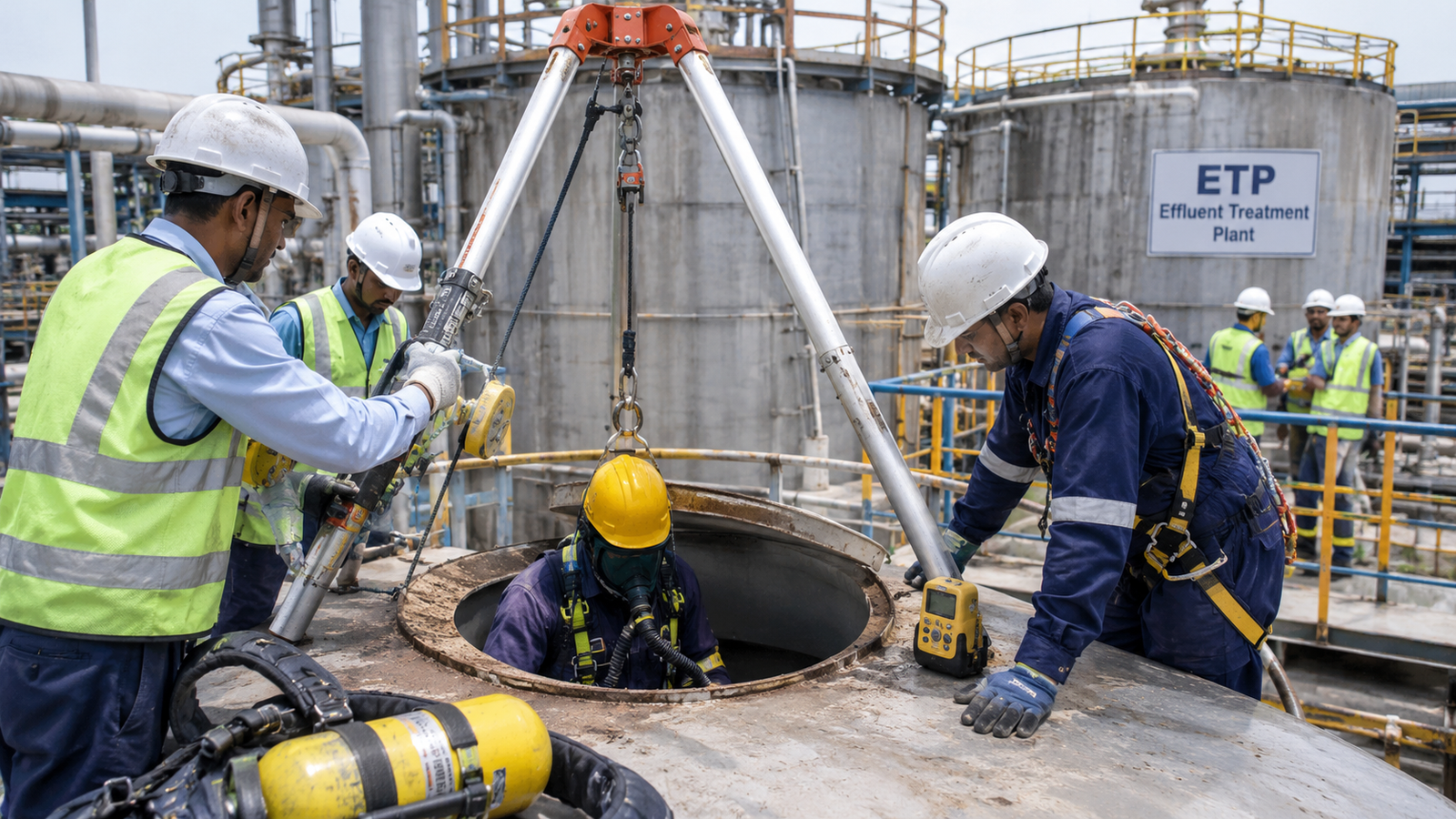
ETP tank safety is critical during maintenance and cleaning because workers may face serious confined-space hazards. These include oxygen deficiency, toxic gases and difficulty escaping during an emergency. The reported deaths of three contract workers at a Tata Electronics facility in Tamil Nadu highlight why industries must verify entry permits, atmospheric conditions and rescue arrangements before allowing anyone to enter a tank.
Essential ETP Tank Safety Measures for Industrial Facilities
1. What Happened at Tata Electronics, Tamil Nadu?
According to reports published by The New Indian Express, DT Next and The Times of India, three contract workers died during maintenance and cleaning inside a nano-filtration feed tank at Tata Electronics’ Marigold facility in Vanniyapuram, Krishnagiri district questioning ETP Tank Safety
The incident reportedly occurred on Monday evening, 9 November 2026.
Initial reports describe the following circumstances:
- Three contract workers were carrying out tank cleaning and maintenance.
- The tank was associated with the facility’s ETP operations.
- The workers reportedly became incapacitated or were found unresponsive inside the tank.
- Emergency responders removed them and took them for medical assistance, but they could not be saved.
- Police and district authorities began investigating the circumstances and possible safety lapses.
However, the initial media reports differ in their descriptions. The New Indian Express and DT Next reported suspected asphyxiation or toxic-gas exposure, while The Times of India described the incident as drowning.
Therefore, the specific gas, exposure mechanism and sequence of events remain unconfirmed based on these reports.
The central EHS concern is the uncontrolled risk of entering an industrial tank for cleaning and maintenance. Investigators must establish whether atmospheric hazards, liquid ingress, isolation failures or other factors contributed to the fatalities and check for ETP Tank Safety guidelines and its adherence.
Sources:
- The New Indian Express – Three workers die at Tata Electronics plant
- DT Next – Three contract workers die at Tata plant
- The Times of India – Three contract workers die during tank maintenance
2. Why Are ETP Tanks Dangerous Confined Spaces?
An Effluent Treatment Plant (ETP) contains several tanks, vessels and structures that may present confined-space hazards.
Common examples include:
- Equalisation tanks
- Sludge collection tanks
- Anaerobic treatment tanks
- Neutralisation tanks
- Nano-filtration feed tanks
- Underground sumps
- Sewage collection chambers
- Chemical storage and process vessels
Many of these spaces have restricted entry and exit. They may also have poor natural ventilation and hazardous atmospheric conditions.
These risks become particularly serious during sludge removal, tank cleaning, inspection and maintenance.
Potential atmospheric hazards inside ETP tanks
Hydrogen sulphide (H₂S)
Hydrogen sulphide may develop when bacteria break down organic matter containing sulphur in oxygen-poor conditions.
This highly toxic gas can cause respiratory failure, unconsciousness and death at dangerous concentrations.
Never rely on its rotten-egg smell to detect a leak. At higher concentrations, the sense of smell can become unreliable because of olfactory fatigue.
Methane (CH₄)
Methane may develop during the anaerobic decomposition of organic waste.
It is highly flammable. When mixed with air within its flammable range, it can create an explosion hazard. At high concentrations, methane can also displace oxygen and contribute to an asphyxiating atmosphere.
Oxygen deficiency
Oxygen levels may fall when other gases displace oxygen or when biological and chemical processes consume it.
An oxygen-deficient atmosphere can affect judgement, cause unconsciousness and become fatal without adequate protection.
Other possible hazards include carbon dioxide, ammonia, carbon monoxide, chemical vapours, corrosive substances and biological contaminants.
However, the actual hazards will depend on the tank contents, process history and site conditions. A competent person must establish them through a site-specific assessment. Never assume that an ETP tank is safe simply because someone has emptied or cleaned it before.
3. Seven Critical Controls for ETP Tank Safety
1. Identify confined spaces and conduct risk assessments
Every industrial facility should maintain an updated confined-space register.
First, identify tanks, pits, chambers, vessels and underground structures that meet the applicable confined-space criteria.
Before starting cleaning or maintenance, the responsible team should:
- Conduct a Job Safety Analysis (JSA).
- Identify potential toxic, flammable and asphyxiating atmospheres.
- Review previous tank contents and chemical treatment history.
- Identify possible flooding, engulfment and mechanical hazards.
- Check whether workers can complete the task without entering the tank.
Where possible, use sludge suction pumps, remote cleaning systems and other non-entry methods. These methods can reduce the need for workers to enter hazardous spaces.
Sahasendure’s Industrial Safety Services support structured hazard identification, operational risk assessment and workplace safety systems.
2. Use a Confined Space Entry Permit
The responsible authority must approve a dedicated Confined Space Entry Permit before allowing entry.
A general maintenance permit does not replace a confined-space entry permit.
The permit should clearly record:
- Exact tank or equipment identification.
- Scope and duration of work.
- Names of authorised entrants.
- Gas test results and acceptance criteria.
- Isolation and LOTO confirmation.
- Ventilation arrangements.
- Required PPE and respiratory protection.
- Standby attendant and communication arrangements.
- Emergency and rescue arrangements.
- Permit issuer and receiver authorisation.
The permit issuer must suspend or revalidate the permit whenever conditions change. For example, a ventilation failure, change in work activity or unexpected process condition may make the original permit invalid.
For structured work authorisation and documentation, organisations should establish a formal EHS documentation and system development process.
3. Conduct proper gas testing before entry
Gas testing is one of the most important controls in confined-space operations.
A competent person should use a suitable, calibrated multi-gas detector to check the atmosphere.
Testing should cover:
- Oxygen concentration.
- Flammable gases, expressed as a percentage of the Lower Explosive Limit (LEL).
- Hydrogen sulphide.
- Carbon monoxide.
- Other toxic gases identified through the risk assessment.
Many industrial confined-space programmes use an oxygen concentration of 19.5% to 23.5% and flammable gas below 10% LEL as screening criteria. However, do not treat these values as universal Indian statutory limits. Always check applicable legal requirements, exposure limits and site-specific acceptance criteria.
Before entry, test the atmosphere remotely at different levels of the tank and in potentially stagnant areas.
The competent person should test oxygen first, followed by flammability and toxic contaminants. Sampling locations must account for gas density, tank geometry, internal obstructions and possible gas stratification.
Additionally, the team must check the detector’s calibration status and carry out the required bump testing according to the manufacturer’s instructions and site procedures.
4. Provide continuous atmospheric monitoring and ventilation
A safe initial gas reading does not guarantee that the atmosphere will remain safe throughout the job.
For example, sludge disturbance, chemical reactions, biological decomposition and changes in ventilation can alter atmospheric conditions during work.
Therefore, the responsible team should:
- Provide suitable forced ventilation using clean air.
- Ensure ventilation does not draw contaminants from nearby processes.
- Use continuous atmospheric monitoring where conditions can change.
- Provide personal gas monitors where appropriate.
- Stop work and evacuate workers if alarms activate or readings exceed permitted limits.
Never use oxygen cylinders to ventilate a confined space. Oxygen enrichment can significantly increase fire and explosion risks.
5. Ensure positive isolation and Lockout/Tagout
Before entry, the maintenance team must identify and isolate every potential source of hazardous energy and material ingress.
For ETP tanks, this may include:
- Electrical supply to pumps and agitators.
- Automatic tank-filling systems.
- Inlet and outlet pipelines.
- Chemical dosing lines.
- Steam and compressed-air connections.
- Sludge transfer systems.
- Mechanical and hydraulic equipment.
The team must apply Lockout/Tagout (LOTO), verify zero-energy conditions and use positive physical isolation, such as blinds or spades, wherever the risk assessment and isolation procedure require it.
Simply switching off a pump or closing a valve may not adequately protect workers against unexpected energisation or material ingress.
6. Maintain a dedicated standby attendant
A trained standby attendant must remain outside the confined space throughout the entry operation.
The attendant must:
- Maintain continuous communication with entrants.
- Monitor the number and identity of workers inside.
- Maintain entry and exit records.
- Monitor external conditions and alarms.
- Order evacuation when unsafe conditions develop.
- Raise the emergency alarm and activate the rescue plan.
The attendant must not perform unrelated duties that could distract them or force them to leave the entry point.
Most importantly, the attendant must never enter the tank impulsively to rescue an unconscious worker. Instead, the attendant should activate the planned rescue procedure and call the trained rescue team.
7. Establish a practical emergency rescue plan
Organisations must establish rescue arrangements before allowing entry, not after an emergency occurs.
A suitable rescue plan should identify:
- Rescue team members and their responsibilities.
- Available breathing apparatus.
- Full-body harnesses and retrieval systems.
- Tripods and winches, where suitable.
- Emergency communication arrangements.
- First-aid and resuscitation facilities.
- Ambulance and hospital coordination.
- Rescue access and equipment limitations.
Where feasible, use non-entry retrieval systems to recover an incapacitated worker.
However, if rescuers must enter the tank, only trained and equipped personnel should perform the operation. They must use suitable respiratory protection, such as self-contained breathing apparatus (SCBA), when the atmosphere requires it.
Unplanned rescue entry is extremely dangerous. A worker who enters without protection can become another casualty. As a result, one emergency can turn into a multiple-fatality incident.
4. Indian Legal and Technical References for Confined-Space Work
Organisations must assess confined-space work against applicable occupational safety legislation, state rules and recognised technical standards.
Occupational Safety, Health and Working Conditions Code, 2020
The Occupational Safety, Health and Working Conditions Code, 2020 provides the broader occupational safety framework.
Relevant provisions include:
- Section 6: Establishes employer duties, including maintaining a safe working environment and protecting workers from workplace hazards.
- Section 18: Provides for the Central Government to declare occupational safety and health standards.
- Section 23: Addresses the employer’s responsibility for maintaining health, safety and working conditions.
The Code came into force on 21 November 2025. However, industrial establishments should verify the applicable Central and Tamil Nadu rules, notifications and transitional provisions before determining their specific statutory obligations.
Read the Occupational Safety, Health and Working Conditions Code, 2020 – India Code.
BIS IS 17893:2023 – Work Permit System: Code of Practice
The Bureau of Indian Standards published IS 17893:2023, which covers the Work Permit System.
The standard includes confined-space and vessel-entry permits among the relevant permit categories. Therefore, organisations can refer to it when developing structured work authorisation procedures.
Refer to the BIS official standard listing.
Ministry of Steel – Safety Guidelines for Working in a Confined Space
The Ministry of Steel has published guidance on confined-space identification, risk assessment, entry permits, isolation, gas monitoring, ventilation, standby supervision and rescue arrangements.
Although the document targets the iron and steel sector, its technical principles can also help organisations in other industrial sectors.
Read the Ministry of Steel – Safety Guidelines for Working in a Confined Space.
International technical guidance
The US Occupational Safety and Health Administration (OSHA) provides additional technical guidance on atmospheric testing, ventilation, isolation and rescue arrangements.
Its Technical Manual on Confined Space Hazards offers useful supplementary guidance. However, it does not replace Indian legislation.
For hydrogen sulphide exposure information, consult the NIOSH Pocket Guide to Chemical Hazards.
5. Practical EHS Compliance Checklist for Industries
Before authorising any ETP tank entry, the EHS department and maintenance team should verify each of the following controls:
- Confined space identified and registered.
- Risk assessment and JSA completed.
- Non-entry cleaning options evaluated.
- Confined Space Entry Permit approved.
- Tank emptied and cleaned as required.
- Inlet, outlet and chemical lines isolated.
- LOTO applied and zero energy verified.
- Gas detector calibrated and function-tested.
- Oxygen, LEL and toxic gas readings recorded.
- Atmospheric testing completed at different levels.
- Forced ventilation established.
- Continuous monitoring arrangements available.
- Entrants trained, authorised and medically suitable.
- Appropriate PPE and respiratory protection provided.
- Full-time standby attendant deployed.
- Communication system tested.
- Rescue equipment and trained rescue personnel available.
- Emergency response arrangements briefed.
- Entry and exit records maintained.
- Permit formally closed after work completion.
A checklist works only when the team physically verifies every control. Tick-box compliance without field verification can create a false sense of security.
Organisations can strengthen these arrangements through independent EHS audits and compliance assurance. Such audits can help identify gaps in permit systems, contractor controls, equipment isolation and emergency preparedness.
6. What Should Industrial Organisations Learn from This Incident?
The Tata Electronics incident reminds us that ETP operations need the same level of safety management as other high-risk industrial activities.
Organisations sometimes treat cleaning and maintenance as routine jobs. However, conditions inside tanks can change rapidly, particularly when workers disturb sludge or introduce chemicals.
Therefore, organisations should review their:
- Confined-space registers and risk assessments.
- Contractor management and supervision systems.
- Permit-to-work and LOTO procedures.
- Gas-testing and ventilation arrangements.
- Standby attendant responsibilities.
- Emergency rescue capabilities and practical drills.
Contractors need the same level of hazard information, supervision and emergency protection as employees of the principal establishment.
In addition, EHS managers should conduct practical rescue exercises rather than relying only on classroom presentations. Role-based industrial safety training and capacity-building programmes can improve workers’ understanding of confined-space hazards and emergency responsibilities.
Management must also ensure that production targets and maintenance schedules never override a safe-entry decision.
Conclusion: ETP Tank Safety Must Be Verified, Not Assumed
Three workers lost their lives during an industrial tank-cleaning operation in Tamil Nadu. Although the final investigation must establish the precise cause, the incident highlights the potentially fatal consequences of uncontrolled confined-space work and ETP Tank Safety
Effective ETP tank safety requires more than PPE. It demands systematic hazard identification, gas testing, positive isolation, ventilation, permit-controlled entry, dedicated standby supervision and a tested rescue plan.
For every industrial organisation operating an ETP, sewage treatment plant or process tank, the most important question is not whether workers have entered the tank safely before.
Instead, the organisation must ask whether the atmosphere, equipment, isolation and rescue arrangements have been verified as safe for this particular entry.
At Sahasendure Solutions LLP, we believe that industrial safety must be built into every operation, including routine cleaning and maintenance.
Review your confined-space procedures before the next entry, not after an accident.
Professional disclaimer: This article provides general EHS information and incident-based safety recommendations. It does not replace a site-specific risk assessment, competent-person evaluation, applicable statutory requirements or approved confined-space entry procedures. Organisations must verify current legislation, state rules and technical standards applicable to their establishments.