
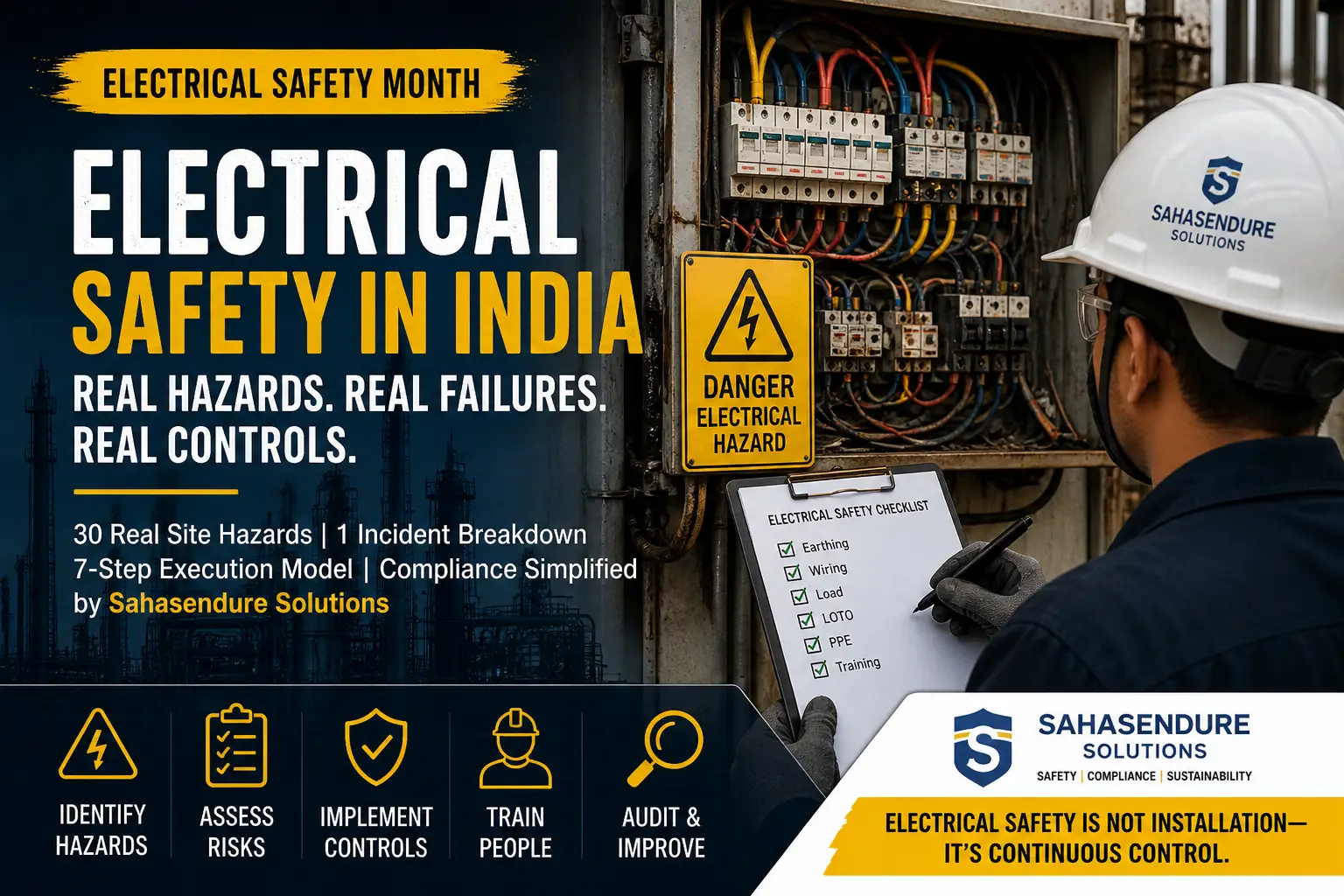
Learn 30 real electrical hazards from Indian construction and factory sites. Expert insights from Sahasendure Solutions on execution-level electrical safety.
Most electrical accidents don’t happen due to lack of rules — they happen because basic risks are ignored on site.
I have walked hundreds of sites across India — steel plants, cement units, high-rise construction projects, pharma facilities, food processing units. In every single one, the same pattern repeats: the SOP binder is on the safety officer’s desk, and the actual electrical panel is a mess of exposed joints, overloaded sockets, and earthing conductors that have never been tested.
Electrical safety in India is one of the most under-executed areas of site safety. It is also one of the deadliest. This article is not a lecture on regulations. It is a ground-level breakdown of what goes wrong, why it goes wrong, and what execution-level control actually looks like.
Why Electrical Accidents Still Happen in India
The gap is not between rules and knowledge. The gap is between what is written in the safety plan and what is actually happening on the shop floor or at the construction site.
Compliance vs. Execution
Most sites in India have electrical safety checklists. Most sites also have overloaded DBs, duct-taped cable joints, and earthing pits that have not been tested in years. Compliance on paper and compliance on the ground are two different realities.
Temporary Wiring Culture
India’s construction and industrial sites run on temporary electrical arrangements that were never meant to be permanent — but always end up being so. “Temporary hai” becomes the justification for every unsafe condition. A temporary DB board installed six months ago is still in use, in the rain, with no cover.
Lack of Ownership and Supervision
Electrical safety on most sites has no clear owner. The electrician manages day-to-day work. The contractor says it is the client’s problem. The EHS officer has no electrical background. Nobody is running periodic checks with authority.
Poor Ground-Level Enforcement
Even when hazards are flagged during audits, closure is rarely tracked. Observations sit in a report, the report gets filed, and the hazard remains on site. This is not a workforce problem — it is a system problem.
30 Real Electrical Hazards From Indian Industrial and Construction Sites
These are not textbook examples. These are observations from actual site audits. Each one has been found, photographed, and reported — repeatedly.
Temporary Wiring
1. Open splice joints in temporary wiring
What actually happens on site: Wire-to-wire connections are made with bare twists and wrapped in low-grade tape that dries and cracks within weeks. These joints are often on the floor, exposed to foot traffic and water.
Practical control measure: All joints must use approved connectors or junction boxes with IP54 rating or higher. Inspect temporary wiring weekly and replace degraded joints immediately.
2. Multi-socket extension boards run across wet floors
What actually happens on site: Extension boards rated for 6A are used to power welding machines and grinders. Multiple adapters are stacked. The board sits on the ground near drainage channels.
Practical control measure: Use industrial-grade distribution boards with individual MCB protection. Elevate all temporary power distribution off the floor by at least 1 meter.
3. Undersized cables for load carried
What actually happens on site: A 1.5 sq mm cable runs a 3-phase motor. Nobody checked the load rating. The cable overheats, the insulation melts, and a fire starts inside a cable tray.
Practical control measure: Conduct load assessment before cable sizing. Follow IS 1554 cable sizing standards. Document and verify load at each distribution point.
4. Temporary DB boards installed without covers or locks
What actually happens on site: Distribution boards sit open on construction sites — no door, no lock, live terminals fully accessible to workers and labourers who are not electrically trained.
Practical control measure: All DBs must have covers, proper door latches, and warning signs. Access must be restricted to authorised personnel through locks and LOTO tags.
5. Overuse of domestic-grade equipment on industrial sites
What actually happens on site: Domestic extension cords, household switches, and domestic-rated MCBs are brought onto construction sites because they are cheaper and easier to procure.
Practical control measure: Enforce industrial-grade equipment standards on site. Domestic-rated equipment must not be permitted on construction or factory sites regardless of availability.
Earthing Failures
6. Earthing conductors disconnected or corroded
What actually happens on site: On paper, the system is earthed. On the ground, the earth conductor is corroded at the clamp point or has been disconnected for a minor repair and never reconnected.
Practical control measure: Test earth continuity at every panel and DB at least quarterly. Use a clamp earth tester. Document readings. Do not accept visual inspection as evidence of continuity.
7. Earth pit resistance never measured
What actually happens on site: An earth pit was installed during commissioning. No one has tested its resistance since. In rocky soil or dry summer conditions, resistance can exceed safe limits by 10x.
Practical control measure: Measure earth pit resistance using the fall-of-potential method. IS 3043 specifies maximum allowable values. Test at least twice annually and after any major excavation nearby.
8. Earthing of portable tools not verified
What actually happens on site: Portable power tools on site have 3-pin plugs but the earth pin is bent, broken, or the socket’s earth terminal is not connected. Workers get low-level shocks and call it “jhatka.”
Practical control measure: Inspect all portable tools with a PAT (Portable Appliance Test) before use. Maintain a register of tested tools. Withdraw any tool with a damaged or missing earth pin.
9. Neutral-to-earth bonding absent in generator sets
What actually happens on site: Sites running on DG sets often skip the neutral-earth bonding at the generator. This creates floating neutral conditions and erratic voltages that damage equipment and create shock risk.
Practical control measure: All generator sets must have the neutral solidly grounded at the source. Verify bonding before energising. Include this in DG pre-start checklist.
10. Equipment metalwork not bonded to earth
What actually happens on site: Steel structural work, cable trays, conduit, and switchgear enclosures are not bonded to the common earth. A fault on any live conductor can energise the entire metalwork.
Practical control measure: All conductive metalwork within 2.5 metres of live parts must be equipotentially bonded to the main earth bar. Include bonding verification in commissioning records.
Panels and Overloading
11. MCBs bypassed with copper wire or jumpers
What actually happens on site: An MCB trips frequently because the circuit is overloaded. Instead of fixing the overload, the electrician bypasses it with a wire. The protection is now gone.
Practical control measure: Conduct a load audit on every circuit that trips repeatedly. Rewire, split loads, or upgrade the MCB rating. Never bypass overcurrent protection devices under any circumstance.
12. Panels energised without arc flash assessment
What actually happens on site: Workers open live MCC panels to check connections, reset breakers, or investigate faults — without arc flash PPE and without any assessment of arc flash incident energy.
Practical control measure: All electrical panels must have arc flash labels per NFPA 70E or equivalent. Provide appropriate PPE (minimum Category 1 for low-voltage panels). Train all authorised workers.
13. No discrimination in protection coordination
What actually happens on site: All MCBs on site are the same rating. A fault downstream trips the main incoming breaker and shuts down the entire site instead of isolating the faulted circuit.
Practical control measure: Design protection coordination with discrimination — downstream devices must trip before upstream ones. Get this verified by a licensed electrical consultant at design stage.
14. Overloaded incoming supply cables
What actually happens on site: The site’s connected load has grown as work has progressed, but the original cable sizing has not been reviewed. Cables run warm to touch and show signs of insulation degradation.
Practical control measure: Re-assess connected load at every major phase of construction or production expansion. Thermally scan incoming cables and busbars quarterly. Upgrade if loading exceeds 80% of rated capacity.
15. No RCDs on circuits used near water or outdoors
What actually happens on site: Residual Current Devices are absent on circuits supplying portable tools, outdoor lighting, and equipment near wet areas. A single earth fault in a wet condition becomes fatal.
Practical control measure: Install 30mA RCDs on all circuits supplying portable equipment, outdoor use points, and areas with water. Test RCDs monthly using the test button and annually using a test instrument.
Cable Damage and Exposure
16. Cables run across vehicle movement areas without protection
What actually happens on site: Armoured or unarmoured cables are laid on the ground across driveways and forklift paths. Vehicles crush the insulation over time, creating earth faults and shock risks.
Practical control measure: All cables crossing vehicle or pedestrian paths must be run through steel conduit or cable bridges rated for the expected load. Mark and protect cable routes clearly.
17. Damaged insulation repaired with insulation tape
What actually happens on site: A cable’s insulation has cracked or been cut. The fix is a wrap of PVC tape. This holds for days, not months. In humid conditions, it fails in hours.
Practical control measure: Any cable with damaged insulation must be replaced, not repaired. If temporary continuation is unavoidable, use heat-shrink sleeves rated for the voltage and environment — not tape.
18. Cables in contact with hot surfaces or sharp edges
What actually happens on site: Power cables are bundled and run alongside steam pipes or exhaust ducts. At sharp conduit edges, insulation wears through from vibration within weeks.
Practical control measure: Maintain separation between cables and heat sources as per IS 732. Use thermal barriers where separation is not possible. Inspect cable routes near process equipment monthly.
19. Open cable ends left live during work breaks
What actually happens on site: When electrical work is paused for lunch or end-of-shift, live cable ends are left exposed, sometimes hanging from cable trays or resting on scaffolding metal.
Practical control measure: All cable ends must be insulated with cap nuts or proper terminal covers whenever work is paused. This is non-negotiable and must be enforced by site supervision, not just electricians.
20. Flexible cables used as fixed wiring
What actually happens on site: Flexible cables, designed for intermittent use with portable equipment, are used as permanent fixed wiring across ceilings, walls, and cable trays because they are cheaper and easier to pull.
Practical control measure: Flexible cables must not be used as fixed wiring. Fixed installations must use appropriate armoured or conduit-housed cables rated for continuous duty. Audit all existing cable types on site.
Wet Conditions
21. Electrical work carried out during rain
What actually happens on site: On construction sites, pressure to meet deadlines pushes electricians to work during rain. They use live tools on wet scaffolding with no rain covers on DBs or panels.
Practical control measure: Electrical work must be suspended during rainfall. Temporary electrical equipment must be covered or housed in weatherproof enclosures. Include weather protocols in electrical work permits.
22. Water accumulation in underground cable ducts
What actually happens on site: Underground cable ducts fill with water during monsoon. Cables rated for dry indoor use are submerged. Insulation fails. Faults go undetected for weeks.
Practical control measure: Use cables with appropriate IP ratings for underground use. Inspect cable ducts post-monsoon. Install sump pits at duct low points and drain regularly. Switch to fully waterproof cable systems.
23. Socket outlets installed without weatherproof covers outdoors
What actually happens on site: Outdoor sockets on construction sites have no covers. Rain, dust, and cement slurry enters the socket housing. Contacts corrode and arc on plug insertion.
Practical control measure: All outdoor sockets must be weatherproof rated minimum IP44. Install covers that remain closed when not in use. Inspect all outdoor sockets weekly during monsoon season.
24. Workers operating electrical equipment with wet hands
What actually happens on site: Workers completing concrete pours, waterproofing, or cleaning tasks handle power tools and switches with wet hands. No training is given on this specific risk.
Practical control measure: Include wet-hands prohibition in all electrical safety toolbox talks. Provide waterproof gloves for workers near electrical equipment in wet process areas. Supervisor must enforce this at site level.
25. Switchboards near water lines without spill protection
What actually happens on site: DB boards are installed adjacent to water supply lines, drainage points, or cooling systems. A pipe joint failure or overflow puts water directly onto live switchgear.
Practical control measure: Maintain minimum 1-metre horizontal clearance between water lines and electrical panels. Where this is not possible, install splash guards and slope flooring away from panels.
Human Behaviour
26. No LOTO procedure before electrical maintenance
What actually happens on site: A fitter needs to replace a motor coupling. He tells the electrician to “switch off.” The electrician switches off at the local isolator. The main breaker is live. Another worker re-energises remotely.
Practical control measure: Implement a formal LOTO electrical safety procedure. Isolation must include all energy sources, personal padlocks, and a recorded isolation certificate. LOTO is not optional — it is the minimum standard.
27. Untrained workers performing electrical tasks
What actually happens on site: At many smaller sites and factories, helpers and general workers connect cables, replace fuses, and reset tripped breakers because calling a licensed electrician takes time.
Practical control measure: Only licensed electricians (as per Indian Electricity Rules) must perform electrical work. Maintain a register of authorised persons. Display this at every electrical panel and DB location.
28. Overconfidence after years of incident-free operation
What actually happens on site: Experienced workers who have worked with live equipment for 10 years without an incident are often the most resistant to safety controls. This overconfidence has caused fatal accidents across India.
Practical control measure: Years without an incident is not proof of safety — it is evidence of luck. Reinforce safe work method statements through refresher training and site supervision, regardless of worker experience.
29. Illegal tapping from overhead lines
What actually happens on site: At construction and temporary labour sites, power is tapped directly from overhead 11 kV or LT lines using bare wires. This is both illegal and frequently fatal.
Practical control measure: Report illegal tapping to the local distribution licensee immediately. Provide and enforce legitimate power supply through proper temporary electrical infrastructure. Zero tolerance must be enforced by the principal contractor.
30. No incident reporting for near-misses and minor shocks
What actually happens on site: Minor electrical shocks — jhatkas — are normalised on site. Workers do not report them. These near-misses are the strongest warning signals before a fatality occurs.
Practical control measure: Create a no-blame reporting culture. Record every shock, trip, and near-miss in the electrical safety incident log. Investigate and close out the root cause within 48 hours.
One Incident. Five Failures. One Root Cause.
What Happened
A contract electrician at a manufacturing plant was tasked with replacing a contactor inside an MCC panel. The panel was switched off at the local isolator. While he worked inside the panel, a production supervisor remotely reset the main breaker from the control room to restore power to an unrelated circuit. The electrician received a fatal shock.
Five Failures That Made It Happen
- No LOTO procedure was in place — the isolation was verbal, not locked out.
- No permit-to-work system existed for electrical maintenance tasks.
- The production supervisor had no visibility of ongoing electrical work in the panel.
- The electrician worked alone without a trained standby person.
- No pre-task safety briefing had been conducted for this specific maintenance activity.
Root Cause
This was a system failure, not a worker fault. The plant had no formal electrical safe work system. The contractor had not been integrated into any permit-to-work process. The production team had no protocol for coordinating with maintenance teams before energising. Every layer of protection was missing. The electrician did what he was told, the way it was always done — and he did not come home.
How Sahasendure Solutions Executes Electrical Safety on Site
This is the 7-step execution model we apply across industrial and construction sites. It is not an audit checklist — it is a working system.
Step 1 — Site Survey
Walk the entire site to map the existing electrical infrastructure, identify all temporary arrangements, and document current hazards with photographic evidence. This is done before any report is written.
Step 2 — Load Assessment
Measure actual running loads at each DB and panel using a clamp meter. Compare against designed capacity. Identify overloaded circuits and document load growth trends.
Step 3 — Earthing Validation
Test every earth pit resistance with a proper earth tester — not visual inspection. Test all earthing conductors for continuity. Record results against IS 3043 acceptable limits and issue corrective actions where values are out of range.
Step 4 — Thermal Scanning
Use a calibrated thermal imaging camera on all panels, DBs, cable joints, and bus connections under load. Hotspots are ranked by severity and closed out against a deadline. This step often catches faults that have been developing for months.
Step 5 — LOTO Implementation
Develop site-specific LOTO procedures for all electrical isolation points. Issue personal padlocks and hasp sets. Train all maintenance workers on the procedure. Audit LOTO compliance at least once per week.
Step 6 — Training
Conduct electrical safety toolbox talks for all workers — not just electricians. Cover safe distances, prohibition on untrained workers handling electrical equipment, emergency response, and the LOTO procedure. Training is documented and signed.
Step 7 — Audit and Closure
Conduct a structured electrical safety audit at 30-day intervals. Track all open observations to closure with photographic evidence. No observation stays open beyond the agreed closure date.
The Most Ignored Electrical Risks in India — Right Now
If I had to pick the top risks that site management consistently underestimates, this is the list:
- Earthing systems that were installed and never tested again — many have degraded beyond safe resistance values and nobody knows.
- Illegal energy tapping in temporary labour accommodation areas connected to the main site supply.
- Open panels and exposed terminals in areas accessible to all workers, not just authorised electrical personnel.
- Extension boards used as permanent power distribution in offices, stores, and site containers — overloaded and unprotected.
- No arc flash assessment or labelling on any MCC or HT panel — workers open these with bare hands.
- LOTO treated as a form-filling exercise rather than a physical isolation system with personal locks.
- Generator neutral not bonded to earth — floating neutral conditions causing unexplained equipment failures and shock complaints.
Electrical Safety Compliance in India — What Actually Applies to Your Site
You do not need to memorise every regulation. You need to know what they require on the ground.
Indian Electricity Rules, 2005
This is the primary legislation governing electrical installations in India. Rules 45 to 67 cover installation requirements, safety distances, earthing, and the requirement that all electrical work must be carried out by licensed persons. Rule 44 deals with supply and use of energy and is the basis for action against illegal tapping.
CEA (Central Electricity Authority) Regulations, 2010
The CEA Regulations on Measures Relating to Safety and Electric Supply are the technical backbone for installation safety. They cover earthing requirements, protection devices, working clearances, and inspection obligations. Regulation 41 on earthing and Regulation 46 on periodic inspection are the two most commonly violated on sites.
Factories Act, 1948 and OSH Code, 2020
Section 36 of the Factories Act and corresponding provisions in the OSH Code, 2020 require that all electrical equipment be of substantial construction, properly maintained, and used safely. The OSH Code extends these protections to contract and gig workers, which means your contractual workforce has the same legal protections as your permanent employees. Contractors cannot transfer this liability to their client through a contract clause.
Final Takeaway
Electrical safety is not installation — it is continuous control.
Wiring a site correctly at the start is the beginning of electrical safety, not the end of it. The system degrades with load growth, temporary extensions, weather exposure, maintenance shortcuts, and workforce turnover. Without active monitoring, re-testing, and enforcement, the best-designed system will develop hazards within months.
The 30 hazards listed above are not hypothetical. They exist on sites across India today — in manufacturing plants, construction projects, utilities, and infrastructure facilities. Most of them will not be visible in your next internal inspection because the people doing the inspection have been normalised to the conditions.
An external, execution-focused electrical safety audit sees what familiarity hides.
Work With Sahasendure Solutions
Sahasendure Solutions provides on-site electrical safety audits, earthing validation, LOTO system implementation, arc flash assessments, and compliance support for industrial and construction sites across India. Our work is execution-level — we do not just report hazards, we close them out. If your site needs a structured electrical safety review, contact Sahasendure Solutions today and let us start with a site walkthrough.