
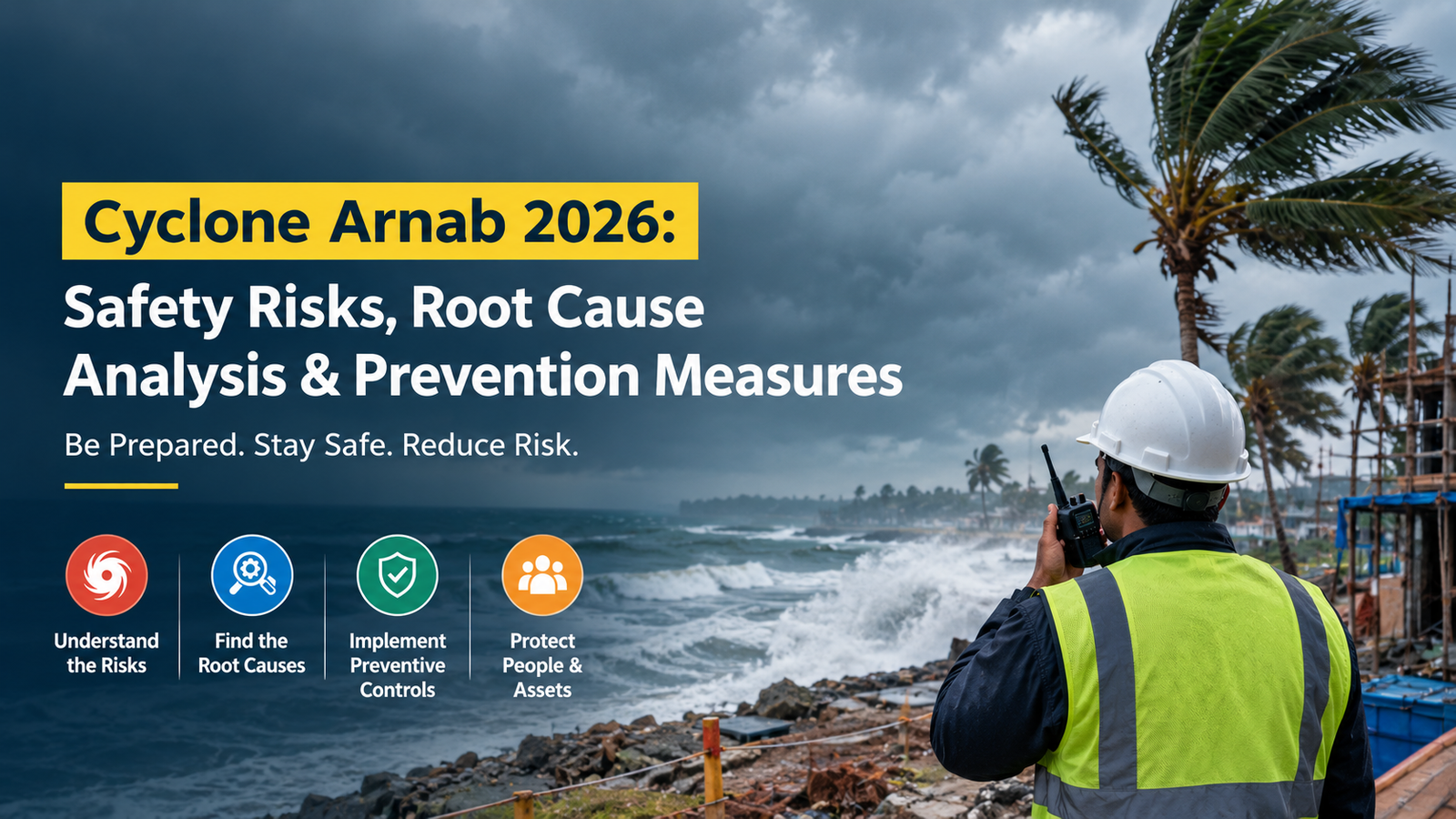
Category: EHS Safety | Disaster Management | Risk Assessment
Author: Sahasendure Solutions LLP
Date: 27 October 2026
⚠️ Can Your Workplace Withstand a Severe Cyclone?
As Cyclone Arnab approaches the Andhra Pradesh coast, one critical question demands attention:
Are our emergency plans capable of preventing accidents—or do they exist only on paper?
Forecasts of severe winds, torrential rainfall and potential coastal flooding highlight the importance of proactive disaster preparedness. Construction sites, industrial facilities and coastal communities face potential risks that require timely decisions, effective controls and reliable emergency communication.
At Sahasendure Solutions LLP, we believe that effective safety management begins before an emergency occurs.
Safety alert: Follow the latest official IMD forecasts and local government instructions. The root cause scenarios discussed below are potential control failures, not confirmed findings from Cyclone Arnab.
🌊 1. Cyclone Arnab 2026: Major Safety Risks
According to the India Meteorological Department (IMD) forecast available on 27 October 2026, Cyclone Arnab is expected to cross the Andhra Pradesh and Yanam coasts between Bapatla and Visakhapatnam, near Yanam, by the forenoon of 28 October.
Forecast sustained wind speeds are 115–125 km/h, with gusts reaching 140 km/h.
These conditions can create multiple hazards:
| Hazard | Potential safety consequence |
|---|---|
| Severe winds | Structural damage and flying debris |
| Heavy rainfall | Flooding and unsafe access routes |
| Storm surge | Coastal inundation and drowning |
| Damaged electrical systems | Electrocution and fire |
| Communication disruption | Delayed evacuation and rescue |
| Damaged infrastructure | Unsafe re-entry and premature restart |
Key concern: One hazard can trigger several secondary emergencies. Flooding, for example, may damage electrical equipment, interrupt access routes and delay emergency response.
🔍 2. Root Cause Analysis (RCA): Where Can Safety Fail?
Root Cause Analysis helps identify why an incident could occur and which underlying weaknesses must be addressed to prevent recurrence.
🚧 Scenario 1: Structural Failure and Falling Objects
Potential failure: Scaffolding components, roofing sheets, hoardings or unsecured materials become hazardous during high winds.
Possible underlying weaknesses:
- Inadequate pre-cyclone inspections.
- Poor securing arrangements.
- Unclear work suspension criteria.
- Failure to identify vulnerable temporary structures.
Preventive controls:
- Secure vulnerable materials while conditions remain safe.
- Suspend exposed work as required by site conditions and official instructions.
- Restrict access beneath unstable structures.
- Arrange competent inspections before work resumes.
⚡ Scenario 2: Electrical Hazards and Electrocution
Potential failure: Workers or residents encounter fallen power lines, damaged electrical installations or electrified floodwater.
Possible underlying weaknesses:
- Inadequate electrical isolation procedures.
- Uncontrolled access to hazardous areas.
- Failure to recognise damaged wires as potentially live.
- Premature restoration of electrical supplies.
Preventive controls:
- Treat fallen electrical wires as live.
- Keep people away from damaged installations and flooded electrical areas.
- Follow authorised utility shutdown and restoration procedures.
- Allow only authorised personnel to inspect and restore electrical systems.
🌊 Scenario 3: Delayed Evacuation and Flood Exposure
Potential failure: People remain in low-lying or exposed locations despite official warnings.
Possible underlying weaknesses:
- Unclear emergency responsibilities.
- Incomplete evacuation arrangements.
- Ineffective communication.
- Failure to identify vulnerable people and locations.
Preventive controls:
- Follow official evacuation instructions immediately.
- Assign responsible evacuation coordinators.
- Verify personnel accountability.
- Move to designated shelters or suitable buildings outside threatened areas.
🏭 Scenario 4: Premature Restart After the Cyclone
Potential failure: Industrial or construction activities resume before hazards have been assessed.
Possible underlying weaknesses:
- Inadequate post-event inspections.
- No formal restart authorisation process.
- Unresolved electrical or structural hazards.
- Pressure to resume operations without verifying safety.
Preventive controls:
- Inspect affected structures, utilities and access routes.
- Document critical defects and corrective actions.
- Obtain competent assessment and required clearance.
- Resume operations only when applicable safety requirements have been satisfied.
RCA takeaway: These are potential causes to investigate, not confirmed findings about Cyclone Arnab. Actual root causes require supporting evidence from inspections, records, interviews and incident investigations.
🛡️ 3. Which Safety Controls Actually Prevent Harm?
Effective cyclone preparedness requires more than warnings and awareness sessions. Organisations should prioritise the following controls.
1. Eliminate exposure
Suspend dangerous work, evacuate threatened areas and prevent access to locations closed by authorities.
2. Apply engineering controls
Secure vulnerable installations before dangerous conditions develop, protect critical infrastructure and assess structural and flood-related risks.
3. Strengthen administrative controls
Activate emergency plans, assign responsibilities, maintain reliable communication and verify personnel accountability.
4. Use appropriate PPE
Provide suitable protective equipment for authorised preparation and recovery activities. PPE cannot replace evacuation or effective isolation of serious hazards.
Important: Never send workers outside to secure equipment once conditions have become dangerous.
🏗️ 4. Cyclone Safety Checklist for EHS Managers
Before severe weather affects a construction or industrial site, verify the following:
- Monitor official IMD forecasts and local government instructions.
- Identify vulnerable locations and personnel requiring assistance.
- Confirm evacuation routes and designated shelters.
- Suspend exposed activities as required by conditions and official orders.
- Secure vulnerable materials while it remains safe to do so.
- Prepare emergency communication equipment and backup power.
- Review electrical isolation and hazardous-area access procedures.
- Secure hazardous substances and assess possible environmental releases.
- Confirm emergency contacts and medical support arrangements.
- Record outstanding hazards and corrective actions.
🚨 During the cyclone
Remain in designated safe locations and follow official instructions. A temporary lull during the cyclone’s eye does not mean the danger has passed.
✅ After the cyclone
Stay away from damaged structures, floodwater and fallen electrical lines. Do not resume work until the relevant hazards have been assessed and required clearance has been obtained.
📋 5. From Emergency Response to Continuous Improvement
A strong EHS management system does not stop when the immediate danger passes. It evaluates whether the controls worked and what must improve.
| Phase | Required action |
|---|---|
| Before impact | Assess hazards and activate the emergency plan |
| During emergency | Maintain communication and personnel accountability |
| After impact | Inspect structures, utilities and access routes |
| Before restart | Close critical safety findings and obtain clearance |
| After recovery | Review findings and improve emergency procedures |
Every corrective action should have a responsible owner, a completion deadline and a method for verifying effectiveness.
Simply issuing a warning or repeating a training session may not resolve an underlying equipment, planning or management-system failure.
💡 6. Five Safety Lessons for Project Leaders
01. Prepare before exposure. Evacuation and work suspension decisions must not be delayed until conditions become dangerous.
02. Control hazards at source. Awareness alone cannot secure a structure or isolate a damaged electrical installation.
03. Establish accountability. Every critical action needs a responsible person and evidence of completion.
04. Verify before restarting. The end of severe weather does not automatically make a workplace safe.
05. Learn from every emergency. Use verified findings to improve procedures, resources and risk controls.
🤝 7. Strengthen Your EHS Preparedness with Sahasendure Solutions LLP
Effective emergency preparedness combines competent personnel, practical procedures, reliable controls and continual improvement.
Sahasendure Solutions LLP supports organisations through:
- EHS risk assessment and hazard identification.
- Safety audits and inspection support.
- Emergency preparedness and response planning.
- Industrial safety training and workforce awareness.
- Corrective action tracking and continual improvement.
Is your organisation prepared for the next emergency?
Review your workplace risks before an emergency exposes weaknesses in your safety arrangements.
Visit: https://sahasendure.com/
Sahasendure Solutions LLP | Safety. Preparedness. Risk Control.
Frequently Asked Questions
What are the main safety risks during a cyclone?
Major risks include structural damage, flying debris, flooding, storm surge, electrocution, communication disruption and unsafe recovery activities.
What is Root Cause Analysis in EHS?
Root Cause Analysis is a structured method for identifying underlying factors that contribute to an incident or control failure and developing corrective actions to reduce the likelihood of recurrence.
How should construction sites prepare for a cyclone?
Construction sites should monitor official alerts, assess vulnerable areas, activate emergency plans, suspend exposed work when required, secure materials safely and verify evacuation arrangements.
When can work resume after a cyclone?
Work should resume only after relevant restrictions have been lifted and competent personnel have assessed affected structures, electrical systems, access routes and other critical hazards.
Where can official cyclone alerts be checked in India?
Consult the India Meteorological Department at https://mausam.imd.gov.in/ and follow the instructions of the relevant state and district authorities.
Official Sources
- India Meteorological Department: https://mausam.imd.gov.in/
- Press Information Bureau, Government of India: https://www.pib.gov.in/
- Andhra Pradesh State Disaster Management Authority: https://apsdmagis.ap.gov.in/weather-watch/lite.html
Disclaimer: This article provides general information on cyclone safety, emergency preparedness and risk management. Forecasts and government arrangements may change. Follow current official warnings, evacuation orders and competent professional advice. Potential RCA scenarios in this article are not confirmed incident findings.
Sahasendure Solutions LLP — Safety. Preparedness. Risk Control.