

A serious road accident is rarely just a matter of two vehicles colliding. Instead, it also raises questions about driver behaviour, vehicle condition, journey planning, fleet supervision and the effectiveness of transport safety controls.
On 13 November 2026, a passenger minibus and a container truck collided head-on near Rangajan in Golaghat district, Assam, on National Highway 715, close to Kaziranga National Park. The tragedy claimed at least 25 lives, according to a district administration update reported on 14 November. However, earlier reports recorded different casualty figures as injured passengers were transferred to hospitals.
The incident has also brought attention to reported previous speeding violations associated with the passenger vehicle. Although these reports do not establish the cause of the collision, they nevertheless raise an important fleet safety Management question:
Could an effective Fleet Safety Management System have identified and controlled the warning signs before this accident?
For organisations using company vehicles, buses, logistics fleets or transport contractors, the answer begins with a simple principle: road safety must be managed before a vehicle enters the road. In other words, prevention must begin before the journey.
1. Incident Overview: The Assam Highway Collision
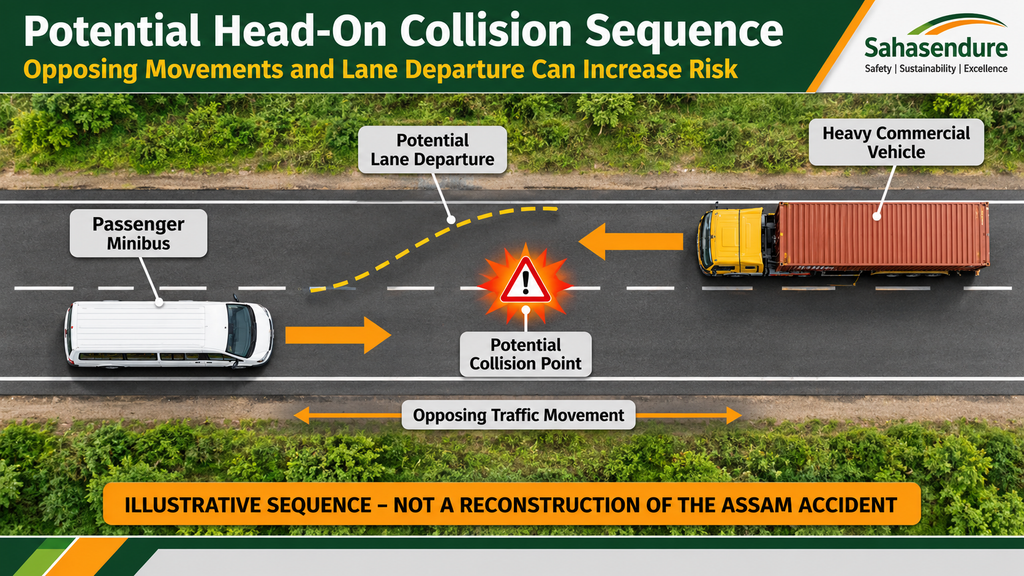
The accident occurred near Rangajan, close to Hathikuli Tea Estate in the Kohora range of Golaghat district.
| Incident detail | Reported information |
|---|---|
| Date | 13 November 2026 |
| Approximate time | Around 2:30 PM, as reported by media |
| Location | Rangajan, Golaghat district, Assam |
| Road | National Highway 715 |
| Passenger vehicle | Minibus / Traveller |
| Other vehicle | Container truck |
| Fatalities | At least 25 in the 14 November district update |
| Injuries | Several; reported totals varied |
| Investigation | Authorities reported that an inquiry would examine the circumstances |
According to reports, the passenger vehicle was travelling towards Nagaon, while the container truck was travelling towards Upper Assam. However, reports differed on the precise starting point of the passenger journey.
The New Indian Express reported that the vehicles collided head-on and that passengers were trapped inside the damaged minibus. Following the collision, rescue operations involved police personnel and local residents. Injured people were taken to nearby hospitals, with some subsequently transferred for advanced treatment.
Casualty verification note: The New Indian Express initially reported 26 deaths, citing a hospital official. Meanwhile, an ANI report published on 14 November quoted Golaghat’s Additional District Commissioner giving a figure of 25 deaths. Other reports also gave different injury figures. Therefore, the final consolidated casualty figure should be checked against the latest district administration statement before publication.
Sources: The New Indian Express – Assam collision report | ANI – District casualty update, 14 November
2. What Happened? Understanding the Road Safety Risks
Reports indicate that the passenger vehicle collided head-on with a container truck. According to police, the minibus was suspected to have been travelling at high speed and lost control before the collision.
Additionally, a dashcam video was reported in the media. However, its authenticity, full context and evidentiary findings must be established by investigators before it is treated as conclusive evidence.
From a road safety perspective, three issues deserve particular attention.
Head-on collision and lane departure
A head-on collision creates a high risk of severe injury because the occupants are exposed to the combined effects of the vehicles’ movement and the impact.
Therefore, if a vehicle crosses into the path of oncoming traffic, investigators need to establish why it happened. Possible lines of inquiry include speed, distraction, fatigue, vehicle handling, road geometry, visibility and an emergency manoeuvre.
Importantly, these are investigation questions, not confirmed causes of this accident.
Vehicle speed and stopping distance
Speed affects both the distance required to react and the distance required to stop. Consequently, even a small increase in speed can significantly affect the distance available to avoid a collision.
For illustration, consider a driver reaction time of 1.5 seconds:
| Vehicle speed | Speed in metres/second | Distance travelled during reaction |
|---|---|---|
| 60 km/h | 16.67 m/s | Approximately 25 metres |
| 80 km/h | 22.22 m/s | Approximately 33 metres |
This calculation covers reaction distance only. In addition, actual stopping distance includes braking distance, which depends on factors such as road surface, tyres, brakes, vehicle load and braking performance.
Collision energy also increases with the square of speed. Therefore, at 80 km/h, a vehicle has approximately 1.78 times the kinetic energy it has at 60 km/h, assuming the same vehicle mass.
However, these are illustrative comparisons, not estimates of the speeds involved in the Assam accident.
Passenger vulnerability
Passenger safety depends on more than the driver’s behaviour. It also depends on authorised seating capacity, suitable occupant restraints, vehicle condition and the structural protection available in a collision.
Media reports suggested that more than 35 people may have been travelling in the minibus. Nevertheless, the exact passenger count and the vehicle’s authorised capacity must be verified from official records.
Consequently, investigators should examine passenger manifests, registration details, permit conditions, seating arrangements and applicable restraint requirements before drawing conclusions about overloading or restraint failures.
3. Root Cause Analysis (RCA): What Must Be Investigated?

A responsible Root Cause Analysis must separate the confirmed event from possible contributing factors. In addition, it should distinguish evidence from assumptions.
At present, the available reporting does not establish a final technical root cause. Therefore, the following framework identifies the evidence that investigators and fleet operators should examine.
A. Immediate event and possible contributing factors
| Investigation area | Questions to examine | Evidence required |
|---|---|---|
| Speed | Was the vehicle exceeding the applicable limit? | GPS data, speed records, CCTV and authenticated dashcam footage |
| Lane position | Why did the vehicles collide head-on? | Accident reconstruction, road evidence and witness statements |
| Driver competency | Was the driver appropriately licensed and competent? | Licence, training and assessment records |
| Fatigue | Had the driver received adequate rest? | Duty roster, journey history and work records |
| Vehicle condition | Were brakes, tyres, steering and suspension serviceable? | Inspection and maintenance records |
| Passenger capacity | Was the vehicle carrying passengers within its authorised capacity? | Registration certificate, permit and passenger count |
| Seat belts | Were applicable restraints fitted and used? | Vehicle specifications and investigation findings |
| Journey planning | Was the route and journey risk assessed? | Route plan, dispatch records and journey approval |
| Fleet monitoring | Were previous violations identified and acted upon? | GPS alerts, challan history and escalation records |
| Contractor supervision | Who monitored the vehicle and driver? | Contract, service-level requirements and audit records |
B. Underlying management-system weaknesses to examine
Even when an immediate event involves driver behaviour, an investigation should examine whether the organisation had systems to identify and control foreseeable risks.
For example, investigators should consider the following questions:
- Was there a process to review repeated speeding violations?
- Did the fleet supervisor receive and act on alerts?
- Were unsafe drivers temporarily restricted from driving where necessary?
- Did the operator verify vehicle fitness and permit conditions?
- Were driver duty schedules reviewed for fatigue risks?
- Did management review repeat violations and serious near misses?
Ultimately, these questions help identify whether the organisation relied only on driver caution or had an effective system of prevention.
C. Five Whys analysis
The following is a preliminary investigation framework, not a conclusion about the Assam accident. Accordingly, each stage must be supported by evidence.
| Why level | Investigation question |
|---|---|
| Why 1 | Why did a head-on collision occur? What was the verified movement of both vehicles immediately before impact? |
| Why 2 | Why did the passenger vehicle enter the path of the truck, if lane departure is confirmed? |
| Why 3 | Did speed, fatigue, distraction, vehicle condition or another factor contribute? |
| Why 4 | Were relevant risks identified and controlled by the vehicle operator or fleet supervisor? |
| Why 5 | Did management have an effective system for monitoring, escalation and verifying corrective actions? |
A Five Whys exercise should continue only when each answer is supported by evidence. Most importantly, it must not be used to force a predetermined conclusion or assign blame without investigation.
4. The Critical Warning: Previous Speeding Violations
One of the most important reported details deserves separate attention.
The New Indian Express reported that an official from the Golaghat District Transport Office described the passenger vehicle as having a history of speeding violations. Specifically, the report stated that the vehicle had received a ₹4,000 fine in Jorhat on 3 March for travelling at 102 km/h. It also reported multiple speeding fines on the Kaziranga stretch and pending challans.
However, these details are attributed to the official quoted in the news report. The underlying challan records and vehicle history should therefore be independently verified before being treated as established evidence.
Nevertheless, the management lesson is significant.
A repeated safety violation is a warning signal, not just a penalty.
Paying a traffic fine does not automatically correct unsafe driving behaviour. Instead, if the same vehicle or driver continues to generate speeding alerts, the operator must investigate why the behaviour is recurring.
A responsible fleet operator should:
- Review traffic challans and GPS speeding alerts regularly.
- Identify repeat violations by driver and vehicle.
- Conduct a documented discussion with the driver.
- Assess whether training, supervision or operational pressure contributed.
- Apply proportionate corrective action.
- Restrict driving duties where a serious unresolved risk justifies it.
- Verify improvement through subsequent monitoring.
Most importantly, corrective action should be recorded and checked for effectiveness.
In practice, a warning letter without follow-up monitoring is not a complete corrective action.
5. Fleet Safety Management System: Ten Controls Organisations Should Implement
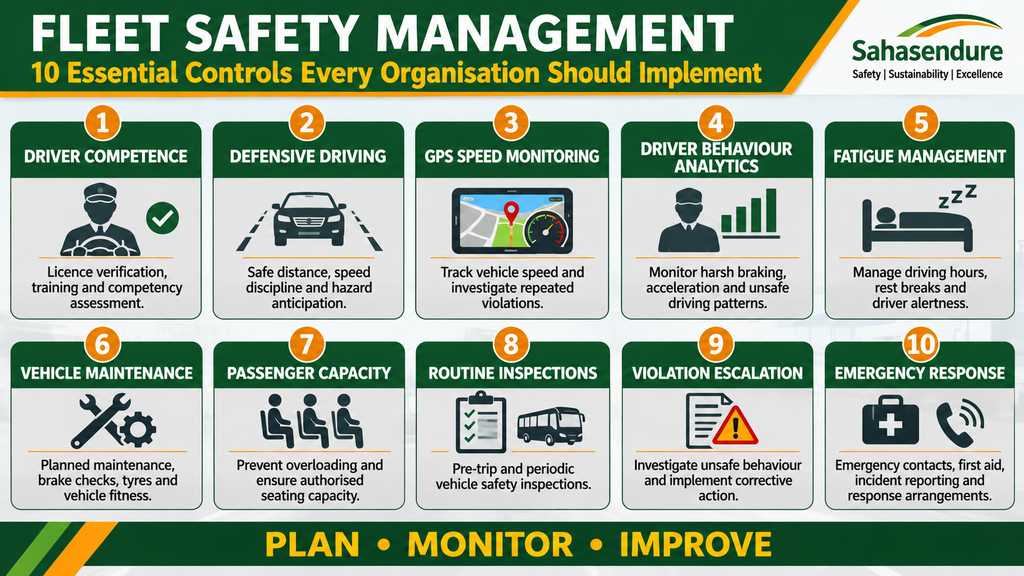
An effective Fleet Safety Management System combines driver competence, vehicle condition, journey planning and management supervision.
To put this into practice, the following ten controls provide a practical framework.
1. Driver selection and competency assessment
Verify the driver’s licence, relevant driving experience, vehicle-category competence and fitness for assigned duties. In addition, assess defensive driving knowledge and practical driving behaviour.
2. Defensive driving programmes
Train drivers to maintain safe following distances, anticipate hazards, manage blind spots, avoid aggressive manoeuvres and respond safely to changing road conditions.
Furthermore, training should include practical assessment, not just attendance.
3. GPS-based speed monitoring
Install suitable vehicle-tracking systems and define speed-alert thresholds based on applicable road limits and organisational requirements.
Thereafter, review repeated alerts and escalate serious or recurring violations.
4. Driver behaviour monitoring
Where suitable technology is available, monitor harsh braking, rapid acceleration, excessive speeding and other relevant driving indicators.
However, technology must support coaching and risk reduction rather than become a substitute for management supervision.
5. Fatigue and journey management
Plan realistic journey schedules, adequate rest breaks and appropriate shift arrangements.
Additionally, establish a process for drivers to report fatigue without pressure to continue driving. Supervisors should also review journey duration, duty history and unexpected delays.
6. Vehicle fitness and preventive maintenance
Maintain a vehicle-specific inspection and servicing schedule.
In particular, pay attention to brakes, tyres, steering, suspension, lights, windscreen visibility and other safety-critical components.
7. Passenger capacity management
Verify the authorised passenger capacity from the registration certificate and applicable permit conditions.
Accordingly, do not allow additional passengers beyond the authorised limit. Also, verify seating arrangements and applicable restraint requirements.
8. Pre-trip and post-trip inspections
Introduce documented inspections before and after journeys.
During these inspections, drivers should report defects immediately. Safety-critical defects must be assessed and resolved before the vehicle is released for service.
9. Violation reporting and escalation
Maintain a central record of challans, speeding alerts, driver complaints, vehicle defects and repeat unsafe behaviour.
Furthermore, assign responsibility for reviewing these records and closing corrective actions.
10. Emergency response and incident reporting
Provide drivers with emergency contact information and clear instructions for reporting collisions, breakdowns and medical emergencies.
Finally, review incidents and near misses to identify lessons that can prevent recurrence.
6. Indian Regulatory and Standards Perspective
Fleet operators must understand both statutory obligations and recommended management practices.
The following provisions are particularly relevant. However, their application depends on vehicle classification, use, permit conditions, state notifications and current amendments.
Motor Vehicles Act, 1988
Section 112 – Limits of speed
This section prohibits driving, or permitting a vehicle to be driven, above the applicable speed limit. Additionally, State authorities may impose restrictions for particular roads, areas or vehicle classes.
For a fleet operator, this means speed compliance must be actively monitored, not merely communicated during induction.
Section 56 – Certificate of fitness
Transport vehicles must meet the applicable fitness-certificate requirements. Therefore, operators should verify certificate validity and ensure that vehicles remain in a compliant condition.
Section 66 – Necessity for permits
Transport vehicles generally require the applicable permit for their use in public places, subject to the statutory provisions and exemptions.
Section 84 – General conditions attaching to permits
Permit conditions include requirements relating to vehicle fitness and permitted speed. Consequently, operators should review both the permit and the vehicle’s compliance status.
Section 194A – Carriage of excess passengers
This provision addresses transport vehicles carrying more passengers than authorised in the registration certificate or applicable permit conditions. In addition, the provision requires excess passengers to be off-loaded and alternative transport arranged before the vehicle moves.
Section 194B – Use of safety belts
This section addresses the use of safety belts by drivers and passengers, subject to the statutory proviso concerning specified transport vehicles.
Reference: India Code – Motor Vehicles Act, 1988.
Central Motor Vehicles Rules, 1989
The CMVR contains requirements relating to vehicle construction, equipment and occupant safety.
For example, Rule 125(1A) addresses seat-belt fitment for specified M1-category vehicles, while Rule 138(3) addresses seat-belt use by occupants of the relevant front-facing rear seats.
In addition, the 2024 amendment to Rule 125 introduced applicable safety-belt assembly and anchorage standards for specified M2, M3 and N-category vehicles manufactured from 1 April 2026.
However, these provisions should not be interpreted as a blanket statement that every seat in every commercial passenger vehicle has identical belt requirements. Instead, operators must verify the vehicle category, manufacturing date, approved configuration and applicable requirements.
References: Ministry of Road Transport and Highways – Central Motor Vehicles (Tenth Amendment) Rules, 2024 | Government of India – Rajya Sabha answer on rear seat belts
ISO 39001:2012 – Road Traffic Safety Management Systems
ISO 39001 provides a management-system framework for organisations that interact with the road traffic system and seek to reduce road traffic deaths and serious injuries that they can influence.
More specifically, it supports:
- A road traffic safety policy.
- Risk-based objectives and action plans.
- Identification of relevant legal and other requirements.
- Monitoring of road safety performance.
- Continual improvement.
ISO 39001 is a voluntary management-system standard unless made applicable through a specific contractual or other requirement. Therefore, it does not replace compliance with Indian motor vehicle laws.
The ISO website confirms that ISO 39001:2012 remains the current published edition, last reviewed and confirmed in 2023, with Amendment 1:2024.
Reference: ISO 39001:2012 – Official ISO page
7. Corrective and Preventive Action Plan (CAPA)
A fleet safety Management should convert audit findings and incident trends into assigned, measurable actions. In this way, identified risks can be addressed systematically.
| Identified risk | Corrective action | Preventive control | Responsible person | Monitoring KPI |
|---|---|---|---|---|
| Repeated speeding | Review violations and counsel the driver | GPS alerts and escalation procedure | Fleet Manager | Repeat speeding events |
| Unsafe driving behaviour | Conduct competency reassessment | Defensive driving programme | Transport Supervisor | Assessment completion and repeat events |
| Vehicle defects | Repair defects before release | Preventive maintenance schedule | Maintenance Manager | Overdue safety-critical defects |
| Poor journey planning | Review route and schedule | Documented journey risk assessment | Dispatch Manager | Journeys reviewed |
| Excess passengers | Stop unauthorised loading | Capacity verification before dispatch | Transport Supervisor | Capacity-related non-compliances |
| Weak fleet monitoring | Review existing tracking coverage | Centralised fleet dashboard | Fleet Manager | Active vehicles monitored |
| Unresolved violations | Close outstanding corrective actions | Monthly management review | Operations Head | Overdue corrective actions |
The organisation should define KPI baselines before setting improvement targets. Furthermore, serious or repeat violations should trigger escalation rather than remain open in a routine monthly report.
8. Practical 15-Point Fleet Safety Management Audit Checklist
Use this checklist during a transport contractor audit or internal fleet inspection. It can also help identify gaps that require corrective action.
| No. | Audit checkpoint | Yes | No | NA |
|---|---|---|---|---|
| 1 | Vehicle registration, insurance and applicable permits are valid | ☐ | ☐ | ☐ |
| 2 | Valid vehicle fitness certificate is available where required | ☐ | ☐ | ☐ |
| 3 | Driver licence is valid for the vehicle category | ☐ | ☐ | ☐ |
| 4 | Driver induction and competency records are available | ☐ | ☐ | ☐ |
| 5 | Speed-monitoring arrangements are implemented | ☐ | ☐ | ☐ |
| 6 | Previous challans and repeat violations are reviewed | ☐ | ☐ | ☐ |
| 7 | Tyres, brakes, steering and lights are inspected | ☐ | ☐ | ☐ |
| 8 | Preventive maintenance records are current | ☐ | ☐ | ☐ |
| 9 | Passenger capacity matches authorised registration and permit conditions | ☐ | ☐ | ☐ |
| 10 | Applicable seat belts and occupant restraints are available and used | ☐ | ☐ | ☐ |
| 11 | Emergency equipment and contact information are available | ☐ | ☐ | ☐ |
| 12 | Journey risk assessment and route planning are documented | ☐ | ☐ | ☐ |
| 13 | Driver fatigue and rest arrangements are reviewed | ☐ | ☐ | ☐ |
| 14 | GPS monitoring and incident reporting are functional | ☐ | ☐ | ☐ |
| 15 | Corrective actions are assigned and verified for effectiveness | ☐ | ☐ | ☐ |
A completed checklist alone does not demonstrate an effective fleet safety management system. Therefore, auditors should verify records, interview drivers, inspect vehicles and observe actual operating practices.
9. Key Lessons for Organisations
The Assam collision offers important learning points for organisations that operate or outsource passenger and goods transportation.
- Monitor behaviour, not just documents. A valid licence and permit do not guarantee safe driving.
- Treat repeat violations seriously. Previous speeding alerts must lead to investigation and corrective action.
- Verify vehicle condition. Safety-critical defects should be resolved before dispatch.
- Control passenger capacity. Never allow operational convenience to override authorised seating limits.
- Plan journeys realistically. Fatigue, route conditions and time pressure must be considered.
- Supervise transport contractors. Outsourcing a journey does not remove the need to verify safety performance.
- Review trends with management. Repeated violations, defects and near misses should be visible to decision-makers.
Ultimately, road safety is a shared responsibility involving drivers, vehicle owners, fleet supervisors, contractors and the organisations using transport services.

10. Conclusion: Road Safety Requires a Management System
The Assam bus–truck collision is a reminder of the severe consequences that can follow when road safety risks are not effectively controlled.
The reported history of speeding violations deserves particular attention. Nevertheless, the final cause of the accident must be established through the official investigation, not assumptions based on media reports.
For organisations operating commercial vehicles, the practical lesson is clear.
Road safety cannot depend on driver caution alone. It requires a system that detects unsafe behaviour, intervenes before an incident and verifies that corrective action works.
A robust Fleet Safety Management System combines competent drivers, road-risk assessment, vehicle maintenance, speed monitoring, fatigue management and accountable supervision.
At Sahasendure Solutions LLP, we believe that risk management must extend beyond the factory gate. Therefore, organisations should apply the same discipline to employee transportation, logistics and contractor-operated vehicles as they do to workplace safety.
Through risk assessments, audits, incident investigation, training and management-system support, organisations can strengthen their approach to operational and transport safety.
Sahasendure Solutions LLP
Built on courage, driven by endurance.
Visit Sahasendure
Frequently Asked Questions
1. What is Fleet Safety Management?
Fleet Safety Management is a structured approach to controlling risks associated with vehicles, drivers, journeys and transport operations. It includes driver competency, vehicle maintenance, speed monitoring, journey planning and incident investigation.
2. Why are repeated speeding violations a fleet safety Management concern?
Repeated violations may indicate unsafe driving behaviour or weaknesses in supervision. Therefore, fleet operators should investigate the reasons, apply corrective action and verify improvement through monitoring.
3. What should a fleet safety Management audit include?
A fleet safety audit should review vehicle documents, driver licences, training, speed monitoring, challan history, maintenance, tyres, brakes, passenger capacity, seat belts, emergency arrangements and corrective-action records.
4. Is ISO 39001 mandatory in India?
ISO 39001 is an international road traffic safety management-system standard. Generally, it is voluntary unless a specific contract, regulatory requirement or other binding condition makes it applicable.
5. Who is responsible for transport safety when vehicles are outsourced?
Responsibility depends on the applicable law, contractual arrangements and each party’s role. However, organisations using transport contractors should establish clear safety requirements, verify contractor performance and monitor identified risks.
About the Author
OSH Consultant | Fire & Safety Professional
Anshul Shridhar is an OSH consultant with an academic background in Fire Technology and Safety. His professional focus includes EHS audits, occupational safety, fire safety, risk assessment, incident investigation and safety management systems.
Through his technical articles and industry insights, he aims to help organisations strengthen workplace safety, improve regulatory compliance and manage operational risks.