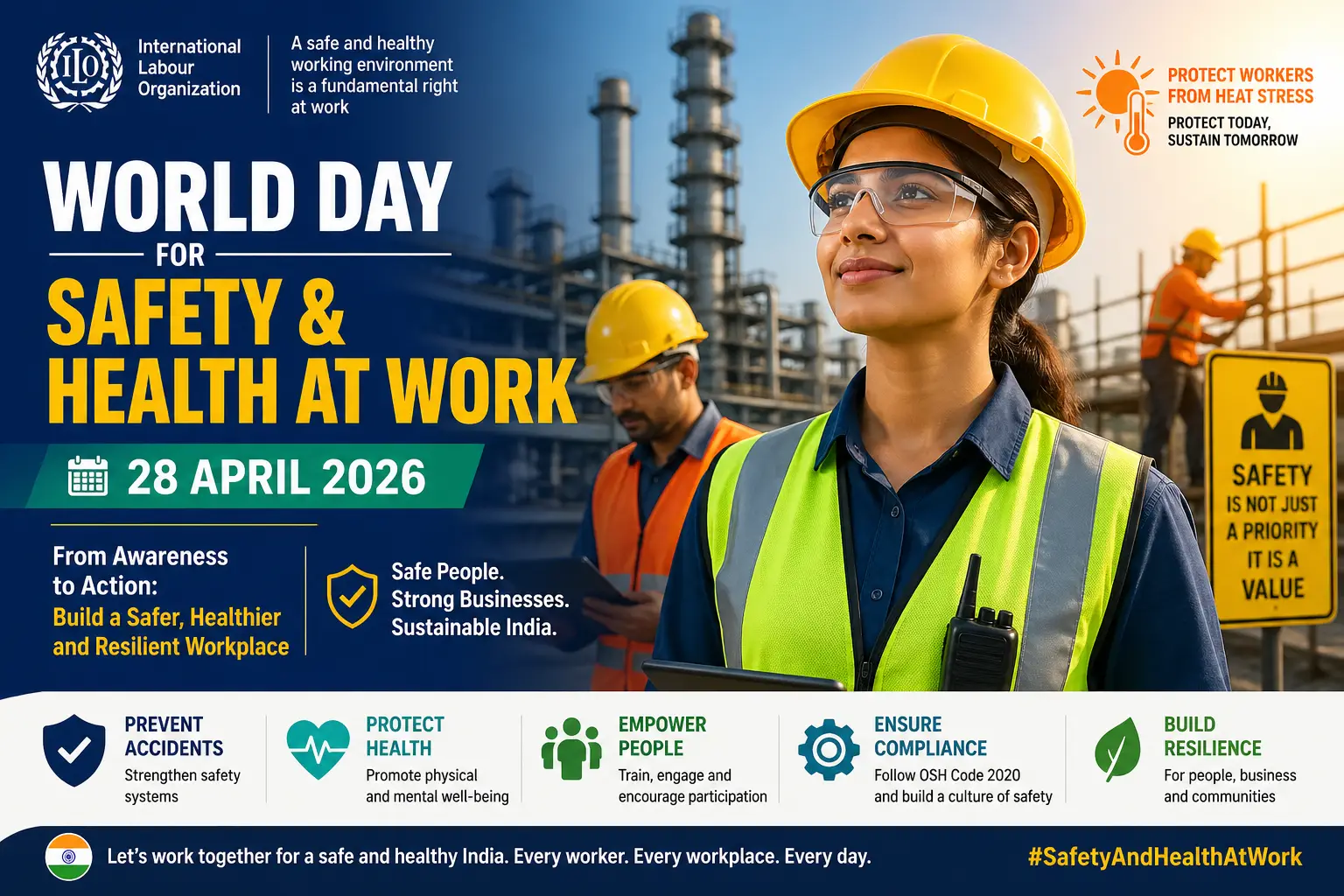
Every year on 28 April, the world pauses to reflect on the millions of workers who go to work and do not come home safely. The World Day for Safety and Health at Work 2026, observed by the International Labour Organization (ILO) and implemented in India through the Ministry of Labour & Employment, is more than a calendar event. For Indian industry, EHS managers, and MSMEs, it is a strategic inflection point — a moment to move from policy intent to measurable action.
Why 28 April Matters: Global Mandate, Indian Urgency
The ILO established 28 April as World Day for Safety and Health at Work to raise awareness of occupational accident and disease prevention globally. The ILO estimates approximately 2.9 million workers die each year from work-related causes, while over 395 million suffer non-fatal injuries annually. The 2026 observance reinforces a principle that is now enshrined in international labour standards: safety is a fundamental right, not a compliance checkbox.
For India, the urgency is compounded by scale. With a workforce exceeding 500 million, India operates one of the most complex occupational ecosystems on the planet — spanning IT parks in Bengaluru, construction sites in Mumbai, textile mills in Surat, and agricultural fields across the Indo-Gangetic plain. The gap between legal obligation and ground-level implementation remains wide. The World Day for Safety and Health at Work 2026 is the annual opportunity — and obligation — to close it.
India Workplace Safety Statistics: The Numbers That Demand Action
Understanding the baseline is the first step in any credible safety strategy. Here is what the data tells us about workplace safety in India:
- The Annual Report of the Ministry of Labour & Employment records tens of thousands of reportable industrial accidents each year, yet experts consistently flag significant under-reporting, particularly from the unorganised sector.
- The construction sector accounts for the highest share of fatal accidents, followed by manufacturing and mining.
- Occupational diseases — including silicosis, byssinosis, and noise-induced hearing loss — affect hundreds of thousands of workers annually. Formal diagnosis and compensation rates remain critically low.
- India’s worker-to-inspector ratio in many states falls well below ILO-recommended standards, creating structural enforcement gaps that leave millions of workers unprotected.
- Migrant and contract workers face disproportionate risk exposure due to limited safety induction, language barriers, and job insecurity that discourages hazard reporting.
These numbers are not abstract. Each figure represents a family, a livelihood, and a preventable loss.
OSH Code 2020: What Changed and What It Means for Your Organisation
The Occupational Safety, Health and Working Conditions (OSH) Code, 2020 is the most significant legislative reform in Indian workplace safety in decades. It consolidates 13 existing central labour laws into a single framework and introduces several critical changes that every EHS manager and business owner must understand.
Key Reforms Under the OSH Code 2020
Expanded applicability: The Code extends formal OSH obligations to establishments with 10 or more workers, bringing a substantially larger segment of MSMEs under its purview for the first time.
Stronger welfare provisions: Mandatory canteens, first-aid facilities, and crèches are codified with clearer applicability thresholds, removing the ambiguity that previously allowed non-compliance.
Hazardous process obligations: Tighter definitions and enhanced employer duties apply to industries handling hazardous substances, with pre-employment and periodic health surveillance requirements.
Contract and migrant worker protections: Principal employers now bear greater direct responsibility for the occupational safety of contract and migrant workers — a significant shift from earlier practice where liability was largely deflected to contractors.
Digital compliance infrastructure: The Code envisions integrated online registration, licensing, and inspection recordkeeping — a move toward transparency and accountability in safety compliance in India.
For EHS managers: State governments are at varying stages of notifying rules under the Code. Organisations that align their safety management systems with the Code’s framework now will be significantly better positioned when full enforcement commences in their jurisdiction.
Critical Gaps: Labour Inspections, MSMEs, and the Informal Sector
Legislative reform alone does not save lives. Three structural gaps continue to undermine occupational health in India, and the World Day for Safety and Health at Work 2026 must focus national attention on all three.
The Labour Inspection Deficit
Many Indian states operate with a fraction of the inspectors needed to cover their registered establishments — let alone the vast universe of unregistered ones. Risk-based inspection models recommended by the ILO are being piloted in some states but have yet to achieve nationwide consistency or coverage.
MSME Awareness and Capacity
India’s 63 million MSMEs generate enormous employment but frequently lack dedicated EHS personnel, safety budgets, or basic awareness of their legal obligations under the OSH Code. For this segment, compliance is often reactive — triggered by an accident rather than driven by prevention culture. Industry associations, government outreach, and affordable third-party safety audits are all urgently needed.
Informal Sector Invisibility
Nearly 90% of India’s workforce operates in the informal economy — domestic workers, street vendors, gig workers, home-based producers, and platform economy participants. The OSH Code’s formal protections largely bypass this population. Bridging this gap requires innovative policy tools: portable benefit accounts, self-regulatory organisation frameworks, and technology-enabled safety awareness in regional languages.
Heat Stress and Climate Risk: India’s Emerging Occupational Health Crisis
Climate change has introduced a rapidly escalating occupational hazard that Indian industry can no longer afford to treat as a peripheral concern: extreme heat. India already ranks among the most heat-vulnerable nations on earth, and the workplace consequences are severe and worsening.
- Outdoor workers — construction labourers, agricultural workers, delivery personnel, and roadside vendors — increasingly face wet-bulb temperatures that approach or exceed safe human physiological thresholds during peak summer months.
- Heat stress causes reduced cognitive function, physical exhaustion, muscle cramps, heat stroke, and death. Even sub-clinical heat exposure suppresses productivity and elevates accident risk throughout a shift.
- The ILO estimates that heat stress could cost India billions in lost working hours annually by 2030, with low-wage outdoor workers bearing the greatest burden.
- Heat stress workers India is an emerging search and policy category — regulatory guidance specifically addressing occupational heat exposure is currently limited but expected to evolve.
Practical Actions for Employers — Right Now
- Schedule heavy outdoor and physically demanding work before 11:00 AM and after 4:00 PM during April–June.
- Provide accessible hydration stations at all outdoor work locations, with water available at no cost to workers.
- Install shaded rest areas near active work zones.
- Train supervisors and workers on heat illness recognition — symptoms of heat exhaustion and heat stroke, and immediate response protocols.
- Incorporate heat risk formally into your workplace Hazard Identification and Risk Assessment (HIRA) under OSH Code obligations.
ESG and ISO 45001: Safety as a Strategic Business Imperative
Occupational safety is no longer purely a regulatory or ethical concern — it is a board-level ESG metric with direct implications for market access, investor confidence, and supply chain eligibility.
ISO 45001 Adoption in India
ISO 45001:2018, the international standard for occupational health and safety management systems, is seeing accelerating adoption among Indian exporters, listed companies, and supply chain participants. Certification signals credible, auditable safety governance to global buyers, procurement teams, and institutional investors. Organisations pursuing industrial safety India credentials increasingly find ISO 45001 a minimum threshold expectation from international partners.
BRSR and Mandatory Safety Disclosure
SEBI’s Business Responsibility and Sustainability Reporting (BRSR) framework — mandatory for India’s top 1,000 listed companies — requires quantitative disclosure of occupational health and safety performance data, including:
- Lost-time injury frequency rates (LTIFR)
- Total recordable incident rates (TRIR)
- Occupational disease incidence rates
- Worker safety training hours and coverage percentages
Global Supply Chain Pressure
Due diligence regulations in the European Union and United Kingdom are creating upstream compliance pressure on Indian manufacturers to demonstrate verifiable safety standards across their operations and supply chains. For Indian exporters, robust OSH performance is no longer optional — it is a market access requirement.
The message is unambiguous: safety investment is not a cost centre. It is a competitive differentiator.
Expected Outcomes of the 2026 Observance
The World Day for Safety and Health at Work 2026 is expected to catalyse the following developments in India’s occupational safety landscape:
- Renewed momentum for state-level OSH Code rule notifications, accelerating the transition from legislative intent to operational enforcement
- ILO-supported capacity building programmes for labour inspectors, MSME safety officers, and trade union safety representatives
- Expanded National Safety Week activities aligned with the ILO’s global 2026 theme across industrial clusters
- Greater industry-academia collaboration on occupational disease surveillance, particularly for silicosis, asbestosis, and musculoskeletal disorders in unorganised sectors
- Stronger ESG disclosure benchmarks for OSH metrics in Indian corporate reporting frameworks, driven by SEBI and institutional investor expectations
- Enhanced heat stress policy guidance from the Ministry of Labour & Employment in response to documented climate-linked occupational fatalities
Action Checklist for Organisations: 10 Steps Before 28 April 2026
Convert awareness into verifiable action. Use this checklist with your EHS team before the observance date.
Step 1 — Conduct an OSH Code gap assessment Map your current safety management system against the specific provisions of the OSH Code 2020 applicable to your establishment size, sector, and hazard category.
Step 2 — Update your Hazard Identification and Risk Assessment (HIRA) Review all existing risk assessments. Ensure they reflect current operations, equipment changes, and any new work processes introduced in the past 12 months.
Step 3 — Add heat stress as a formal risk category Incorporate heat stress into your risk register with specific controls, monitoring triggers, and emergency response protocols for the summer season.
Step 4 — Audit contract and migrant worker safety induction records Verify that all contract workers and migrant employees have received documented safety induction in a language they understand before commencing work.
Step 5 — Check your first-aider ratio and schedule refresher training Confirm your first-aider-to-worker ratio meets OSH Code requirements for your establishment. Schedule refresher certification for lapsed first-aiders.
Step 6 — Conduct a mock emergency drill Schedule and document a mock emergency drill — fire evacuation, chemical spill response, or medical emergency — before 28 April. Record attendance and debrief findings.
Step 7 — Collate incident data for BRSR and ESG reporting Compile LTIFR, TRIR, near-miss frequency, and training coverage data for the current reporting year to support BRSR disclosure and ESG investor queries.
Step 8 — Engage your MSME supply chain on basic safety expectations Issue a supplier safety communication setting out minimum OSH expectations, and offer to share resources or conduct joint safety awareness sessions.
Step 9 — Initiate or renew ISO 45001 certification discussions If your organisation is not yet ISO 45001 certified, use 28 April as the trigger date to initiate a gap analysis and certification roadmap with an accredited certifying body.
Step 10 — Communicate safety commitments to your workforce on 28 April Issue a leadership statement on workplace safety in local languages. Display the ILO’s World Day materials at plant entrances, canteens, and notice boards. Let workers know that their safety is the organisation’s highest priority.
Frequently Asked Questions
What is the theme of World Day for Safety and Health at Work 2026?
The ILO announces the official theme for each year’s observance. The 2026 edition continues the overarching framework of safety as a fundamental right at work, with increased emphasis on climate-related occupational hazards — including heat stress — and inclusive safety frameworks that reach informal and gig workers. Organisations should monitor the ILO’s official website (ilo.org) for the confirmed 2026 theme as 28 April approaches.
Is the OSH Code 2020 fully operational across all Indian states?
The OSH Code 2020 was passed by Parliament, but its full operationalisation depends on state governments notifying their respective rules. As of 2025–26, the progress of rule notification varies significantly by state. EHS managers should actively track their specific state government’s notification status and prepare compliance systems in advance of enforcement commencement in their jurisdiction.
Does ISO 45001 certification replace the need for statutory OSH Code compliance?
No. ISO 45001:2018 is a voluntary international management system standard. It does not substitute for statutory obligations under the OSH Code 2020 or any applicable state rules. However, organisations with a functioning ISO 45001 system are substantially better positioned to demonstrate, document, and continuously improve OSH Code compliance. The two frameworks are highly complementary and mutually reinforcing.
What are the OSH obligations for gig and platform economy workers in India?
This remains a rapidly developing area of Indian labour law. The Code on Social Security 2020 acknowledges gig and platform workers as a distinct category, but comprehensive occupational safety protections for this workforce are still being defined and notified. Organisations engaging platform workers — delivery, logistics, care services, construction aggregators — should proactively implement and document safety guidelines, training, and incident reporting mechanisms even ahead of formal statutory requirements.
From Awareness to Action — Your Next Step Starts Today
The World Day for Safety and Health at Work 2026 is not a moment for passive observation. It is your organisation’s most visible opportunity to demonstrate that safety is embedded in your culture, your operations, and your leadership — not just your policy binder.
Whether you are a large industrial enterprise navigating ISO 45001 certification, an MSME working to understand your OSH Code obligations for the first time, or an EHS manager building the business case for a stronger safety budget, the tools, standards, and frameworks to protect your workforce exist today.
Do not wait for an incident to create urgency.
Explore how our expert team can support your journey — from OSH Code compliance audits and HIRA development to ISO 45001 implementation, EHS training, and ESG safety disclosure support.
Published in observance of World Day for Safety and Health at Work 2026 — 28 April 2026.