
A reported fire at the HPCL Rajasthan Refinery exposes critical gaps in process safety and commissioning-phase risk control.
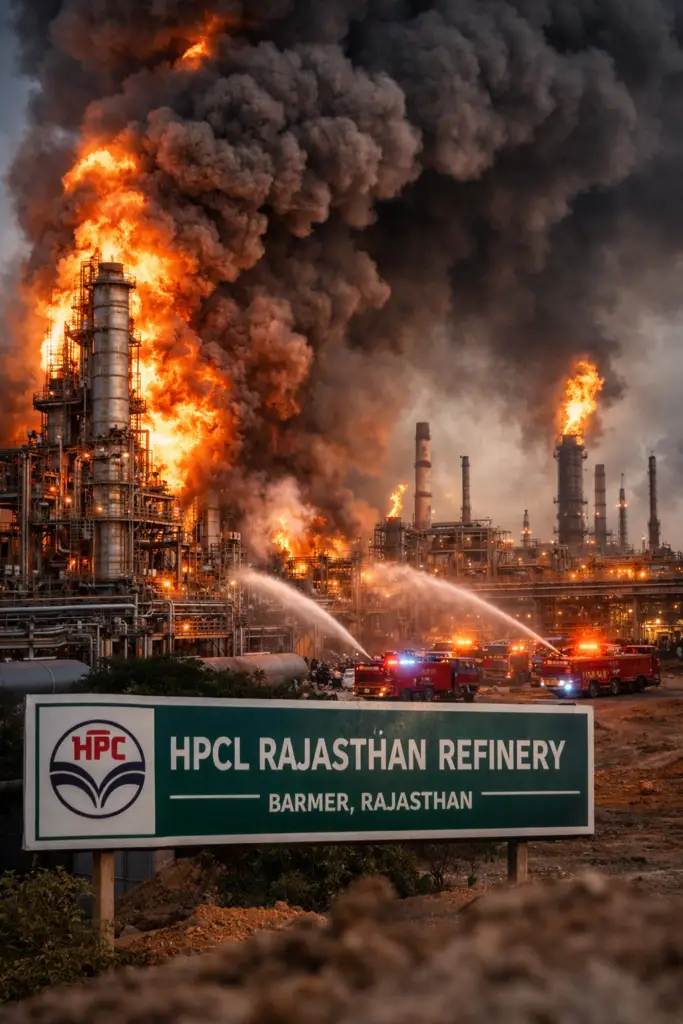
INCIDENT DETAILS
- Date: April 2026 (Exact date not officially confirmed)
- Location: HPCL Rajasthan Refinery
- Area Type: Greenfield Refinery-cum-Petrochemical Complex (Industrial High-Hazard Facility)
- Structures Affected: Under assessment (process units and associated infrastructure)
- People Affected: Not Reported
- Fatalities: Nil Reported
- Injuries: Not Reported
- Emergency Response: On-site refinery emergency response system activated (firewater network, hydrants, trained response teams)
- Incident Time: Not officially disclosed
- Fire Status: Brought under control after sustained firefighting efforts
- Suspected Cause: Under investigation (preliminary indications suggest possible technical/system-related issue)
Incident Summary
In April 2026, a reported fire incident at the HPCL Rajasthan Refinery, a high-hazard, greenfield refinery-cum-petrochemical complex—highlighted critical concerns around process safety management, industrial fire risk, and commissioning-phase hazards. While no fatalities or injuries have been officially reported, the event triggered activation of the refinery’s emergency response systems, including firewater networks, hydrant operations, and trained firefighting teams, bringing the situation under control after sustained efforts.
The exact time and root cause remain under investigation, with preliminary indications pointing toward a potential technical or system-related failure. From an EHS perspective, this incident underscores the importance of robust safety audits, real-time risk monitoring, and emergency preparedness frameworks in large-scale petrochemical operations.
Unsafe Condition Identified
Unsafe Condition Identified: Potential compromise in process safety controls and hydrocarbon containment integrity during commissioning at the HPCL Rajasthan Refinery, increasing industrial fire risk.
- Potential hydrocarbon leakage risk due to compromised containment integrity (flanges, valves, joints) during commissioning activities
- Incomplete stabilization of process parameters (pressure/temperature fluctuations) increasing likelihood of ignition
- Simultaneous multi-contractor operations leading to gaps in coordination and permit-to-work control
- Inadequate segregation of hot work and live hydrocarbon systems, elevating fire/explosion risk
- Possible lapses in gas detection and early warning systems or delayed alarm response
- Fire protection systems not fully performance-tested under live load conditions (hydrant pressure, foam system effectiveness)
- Static charge accumulation risk due to improper earthing/bonding during fluid transfer
- Instrumentation or control system vulnerability (automation/interlocks not fully validated during pre-commissioning)
- Restricted access/egress or congestion in critical zones, affecting emergency response efficiency
- Human factor risks, including limited situational awareness and supervision gaps during high-risk operations
Root Cause Analysis (RCA)
The preliminary Root Cause Analysis (RCA) of the reported fire incident at the HPCL Rajasthan Refinery indicates a likely combination of process safety control gaps and commissioning-phase vulnerabilities rather than a single-point failure. During pre-commissioning or system integration, unstable operating conditions (pressure/temperature fluctuations) may have contributed to a loss of hydrocarbon containment, potentially through flanges, valves, or instrumentation interfaces. This, coupled with the presence of an ignition source—such as hot work, static discharge, or energized equipment—could have initiated the fire. Contributing factors may include incomplete validation of safety interlocks and shutdown systems, gaps in permit-to-work enforcement, and limited real-time monitoring of gas detection systems. Additionally, multi-agency contractor involvement and human factors, such as supervision gaps or communication breakdowns, may have escalated the incident. Overall, the event reflects a systemic lapse in process safety management, pre-startup safety review (PSSR), and integrated risk control during high-risk commissioning activities.
Process Safety & Containment Failure
- Loss of hydrocarbon containment from flanges, valves, or joints—key driver of industrial fire risk in refineries
- Pressure and temperature instability during commissioning leading to unsafe operating envelopes (process safety management gap)
- Inadequate leak detection mechanisms or delayed identification of vapor release (gas detection system effectiveness issue)
- Material integrity or installation defects impacting piping and equipment reliability (mechanical integrity failure)
- Incomplete pre-startup safety review (PSSR) allowing systems to operate without full validation
Ignition Source & Control System Gaps
- Presence of potential ignition sources such as hot work, electrical sparks, or static discharge (refinery fire hazard)
- Improper isolation of energized equipment during hydrocarbon handling (LOTO and energy isolation gap)
- Failure or incomplete validation of safety interlocks and emergency shutdown (ESD) systems
- Gas detection and alarm systems not optimized for real-time response in high-risk zones
- Inadequate earthing and bonding practices, increasing static electricity ignition risk
Human Factors & Permit-to-Work Lapses
- Permit-to-work (PTW) system gaps, especially during simultaneous operations (SIMOPS risk)
- Multi-contractor coordination failure, leading to overlapping high-risk activities
- Supervision and communication breakdowns during critical commissioning tasks
- Insufficient competency or safety training for workforce handling live systems
- Deviation from standard operating procedures (SOPs) under time or project pressure
Key Safety Learnings
- Commissioning phase = highest risk period → enforce enhanced process safety management (PSM) controls before full-scale operations
- Pre-Startup Safety Review (PSSR) must be non-negotiable → ensure all systems, interlocks, and safeguards are fully validated
- Zero tolerance for loss of containment → strengthen mechanical integrity programs for piping, valves, and critical equipment
- Strict Permit-to-Work (PTW) during SIMOPS → control overlapping high-risk activities with real-time authorization and supervision
- Fire protection systems must be performance-tested → validate hydrant pressure, foam systems, and response time under live conditions
- Gas detection and alarm systems require real-time reliability → ensure early leak detection to prevent escalation into fire incidents
- Control ignition sources rigorously → enforce LOTO, hot work permits, and static grounding/bonding practices
- Emergency response readiness defines outcome → conduct scenario-based mock drills simulating real refinery fire conditions
- Contractor safety management is critical → ensure competency, coordination, and accountability across all agencies
- Move beyond compliance to predictive safety → adopt risk-based inspections, digital monitoring, and proactive hazard identification
Recommended Actions
Strengthening Process Safety & System Integrity
- Conduct comprehensive Pre-Startup Safety Review (PSSR) before energizing any live hydrocarbon system
- Validate all safety interlocks, alarms, and Emergency Shutdown (ESD) systems under real operating conditions
- Implement a robust mechanical integrity program for pipelines, valves, flanges, and critical equipment
- Perform pressure testing, leak testing, and line walk-downs to ensure zero loss of containment
- Ensure closure of all HAZOP / HAZID action points with documented verification
- Deploy real-time process monitoring systems to track pressure, temperature, and flow deviations
- Strengthen management of change (MOC) procedures for any last-minute design or operational changes
Enhancing Fire Protection & Emergency Preparedness
- Conduct full-scale performance testing of firewater systems, hydrants, and foam suppression units
- Ensure adequate firewater pressure, redundancy, and coverage across all high-risk zones
- Calibrate and validate gas detection and alarm systems for early leak identification
- Establish a site-specific emergency response plan (ERP) aligned with refinery hazards
- Carry out scenario-based mock drills simulating hydrocarbon fire and explosion situations
- Ensure availability and readiness of firefighting equipment, PPE, and breathing apparatus
- Define and train teams on incident command system (ICS) for structured emergency handling
Improving Operational Control & Workforce Safety
- Enforce a strict Permit-to-Work (PTW) system, especially during commissioning and SIMOPS
- Establish clear SIMOPS (Simultaneous Operations) control protocols to avoid activity overlap risks
- Strengthen contractor safety management, including onboarding, competency checks, and supervision
- Implement toolbox talks and task-specific risk assessments (JSA) before high-risk jobs
- Ensure proper LOTO (Lockout/Tagout) and energy isolation procedures for all energized systems
- Enhance on-ground supervision and communication protocols during critical operations
- Conduct regular safety training and awareness programs focused on refinery fire hazards
ncidents like the one reported at the HPCL Rajasthan Refinery reinforce that compliance alone is not enough—proactive, system-driven EHS frameworks are critical to prevent high-impact industrial incidents.
If your facility is entering commissioning, expansion, or high-risk operations, now is the time to strengthen your process safety systems, fire protection readiness, and emergency response capability with expert EHS support.